






It’s Not You, It’s the Walls
Before blaming the little white box you bought, it’s important to understand the enemy: physics. Wi-Fi signals are radio waves, and like any radio wave, they hate obstacles. Your home’s walls, floors, metal appliances, and even the water in your fish
tank are all actively working to weaken that precious signal. Signals in the 5 GHz band, which offer faster speeds, have an even harder time penetrating solid objects than the older, more crowded 2.4 GHz band. So, a single router, no matter how powerful it claims to be, is fighting a losing battle against the very structure of your home from the start.
The Compromise Box Was Born
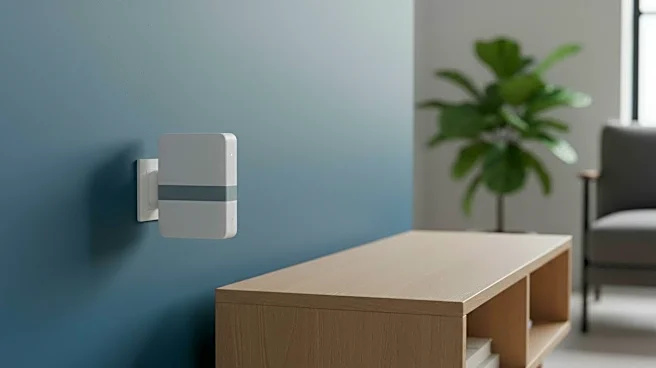
Enter the Wi-Fi range extender, also known as a repeater. The concept is brilliantly simple: place a device where your signal is still decent, and it will catch the signal and rebroadcast it, creating a second bubble of coverage. This was a game-changer for getting a connection to a back bedroom or basement. But this simple design came with a major, built-in compromise. Most basic extenders use the same radio to both listen to the router and talk to your devices. This process, called "half-duplex," effectively cuts your potential Wi-Fi speed in half because the extender can't listen and talk at the same time. It’s like a walkie-talkie, not a telephone.
Good Enough and Cheap Enough
So why would engineers design something with such an obvious flaw? Because it was the perfect solution for the market at the time. Extenders were, and still are, a cost-effective and easy-to-understand fix for a common problem. For a manufacturer, producing a small, simple plug-in device is far cheaper than developing a complex multi-part system. They are easy to package, easy to market, and for many users who just wanted to check emails in the bedroom, the 50% speed loss wasn't a dealbreaker. The design was driven by a classic business trade-off: it was good enough for most people, cheap enough to be an impulse buy, and solved the most immediate pain point without requiring a complex installation.
The Government-Mandated Power Ceiling
A common question is, "Why not just make the main router more powerful?" The answer is that they can't, at least not beyond a certain point. In the United States, the Federal Communications Commission (FCC) sets strict limits on the power output of consumer electronic devices that use unlicensed radio frequencies, like Wi-Fi. For the 2.4 GHz and most 5 GHz bands, the maximum transmitted power is generally capped at 1 watt (1000mW). This regulation exists to prevent your router from interfering with your neighbor's router, and more importantly, with other critical radio services. Manufacturers design their equipment to operate at or just under this legal limit. So, blasting through concrete walls with sheer power was never an option.
Enter the Modern Fix: Mesh Networks
The limitations of the extender model are what ultimately paved the way for its successor: the mesh Wi-Fi system. Instead of one device repeating a weakened signal, a mesh system uses multiple nodes that are designed to talk to each other intelligently. They create a single, unified network across your entire home, and your devices seamlessly connect to the strongest node without you doing a thing. Mesh systems use more sophisticated technology and often have dedicated radios just for communicating between the nodes, which avoids the speed-halving problem of basic extenders. While more expensive, they represent the solution engineers likely wanted to build all along—a system that fixes the Wi-Fi problem holistically, rather than just patching over it.