





1. How Many 'Logical' Qubits Are There?
Headlines love to tout the number of qubits a new machine has, but this is often a vanity metric. The raw number refers to 'physical' qubits, which are incredibly fragile and prone to errors from the slightest disturbance. The far more important number is 'logical'
qubits. A logical qubit is a more stable, reliable, and error-corrected virtual qubit built by grouping many physical qubits together. A machine with a handful of high-quality logical qubits is vastly more powerful and useful than one with thousands of error-prone physical ones. So when you hear a big number, ask: Is that physical or logical?
2. What Is the Error Correction Strategy?
This is the single biggest challenge in quantum computing. Because qubits are so unstable, they create a lot of 'noise' that makes calculations unreliable. Without a robust way to detect and correct these errors, a quantum computer is just a very expensive random number generator. A serious quantum effort will have a clear and sophisticated quantum error correction (QEC) plan. They should be able to explain how they encode information to protect it and how they reverse errors without destroying the quantum state. A vague answer here is a major red flag.
3. What Specific Problem Does This Actually Solve?
Quantum computers are not going to replace your laptop or run your email. They are specialized machines designed to tackle a very specific class of problems that are impossible for even the most powerful classical supercomputers. These problems often involve optimization, simulation, or cryptography. If a company announces a breakthrough, the key question is: what is the practical application? Are they using it for drug discovery, financial modeling, or materials science? A claim without a concrete problem is often a solution in search of a purpose.
4. Is This 'Quantum Supremacy' or 'Quantum Advantage'?
These two terms are often used interchangeably, but they mean very different things. 'Quantum supremacy' is a technical milestone where a quantum computer performs any calculation—even a useless, abstract one—faster than a classical computer could. 'Quantum advantage,' on the other hand, is the real prize. This means the quantum computer solved a useful, real-world problem faster or better than a classical computer. Achieving supremacy is like building a race car that can break a speed record in a vacuum; achieving advantage is like that same car winning a real race. Be wary of supremacy claims that aren't tied to a practical benefit.
5. What Is the Quality of the Qubits?
Beyond the sheer number, the quality of the qubits is paramount. Two key metrics for quality are 'coherence time' (how long a qubit can hold its quantum state before decohering and losing information) and 'gate fidelity' (how accurately operations can be performed on the qubit). A machine with lower-quality qubits that lose their state quickly can't perform complex calculations, no matter how many of them there are. It’s like having a huge team of workers who all have very short attention spans. Progress in coherence and fidelity is often a much better indicator of real progress than just adding more qubits to the pile.
6. How Are They Measuring Performance?
As the field matures, researchers are moving beyond simple qubit counts to more holistic benchmarks. IBM, for example, uses metrics that combine scale (number of qubits), quality (how many operations they can reliably execute), and speed (how many useful computations it can run per second). These multi-dimensional benchmarks provide a much more honest assessment of a machine's true capabilities. When a company makes a performance claim, ask what they are measuring. If the answer is just one number, it's not the full story.
7. Is This a Full-Stack Computer or Just a Component?
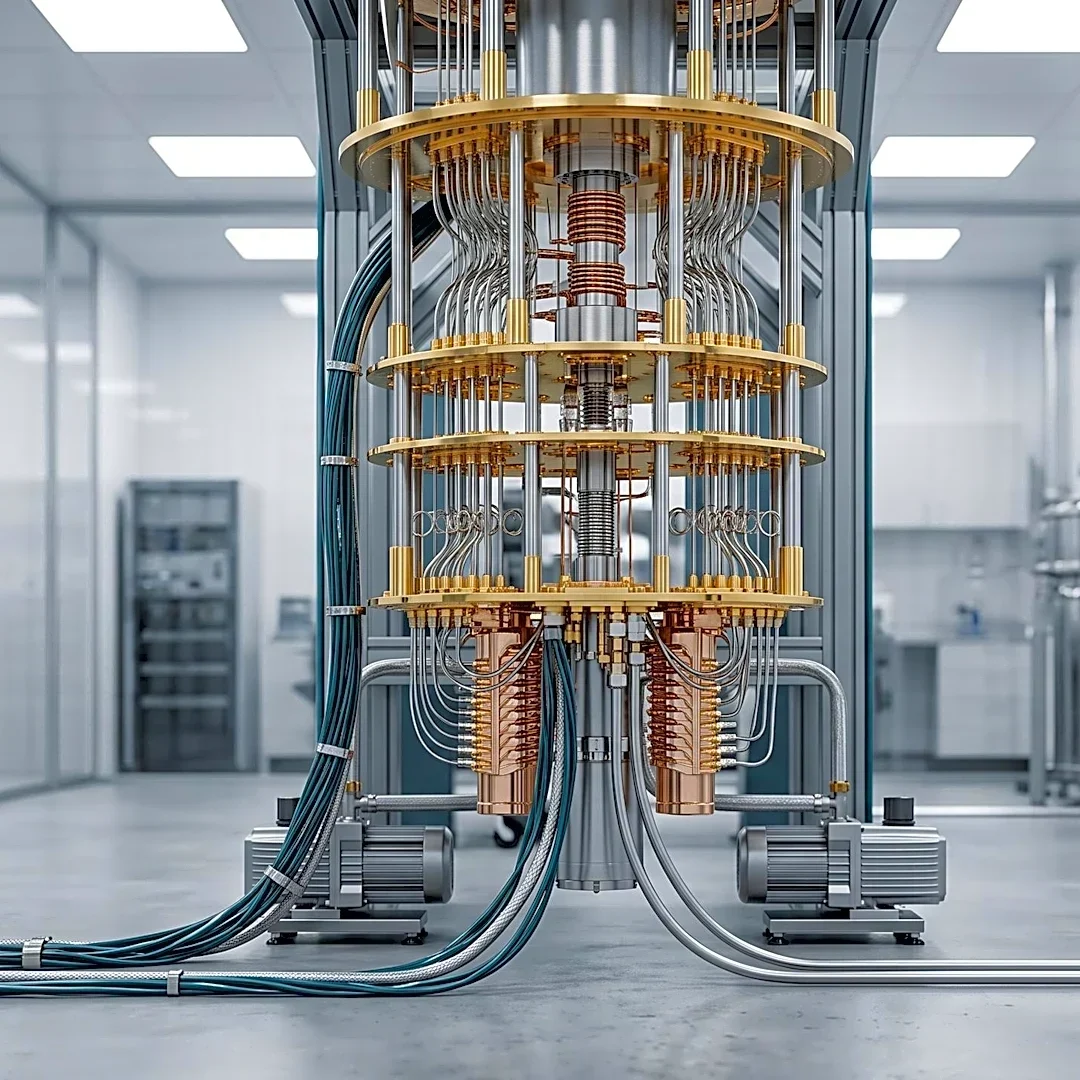
Building a quantum computer isn't just about the quantum processor (the QPU). It requires a massive stack of classical hardware and software for control, cooling, error correction, and readout. Some breakthroughs might relate to a single component—like a better way to connect qubits or a new cooling method—rather than a fully operational computer. While these are important engineering milestones, they are just one piece of an extraordinarily complex puzzle. Understanding whether an announcement is about the whole system or just a part helps place the achievement in its proper context.