





The Tyranny of the Single Router
For the longest time, home internet was a one-box affair. Your internet service provider gave you a modem, and you plugged in a single, powerful (and often intimidating-looking) router. The goal was to blast a Wi-Fi signal from a central point, hoping
it would reach every corner of your house. It was a hub-and-spoke model that rarely worked as advertised. Walls, floors, and even microwave ovens would weaken the signal, creating frustrating dead zones where your connection would slow to a crawl or disappear entirely. The industry’s solution was the Wi-Fi “extender,” a clumsy workaround that often created more problems than it solved. Extenders would create a second, separate network, forcing you to manually switch between them as you moved through your home. This wasn't a seamless experience; it was a digital patch job for a fundamentally broken approach. The prevailing wisdom was that if you wanted better Wi-Fi, you needed a bigger, more powerful, and more complicated router, turning your living room into a command center just to stream a movie.
A Paradigm Shift in a Simple White Box
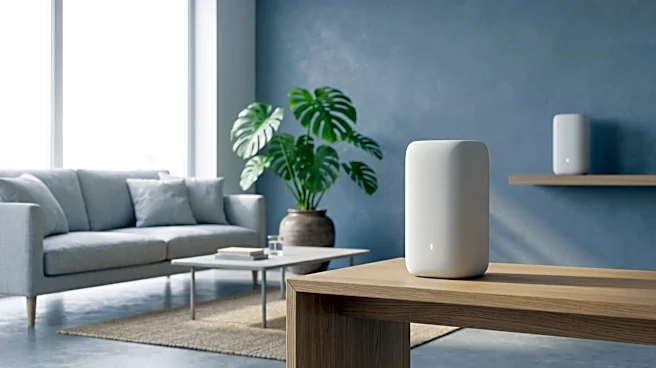
Around the mid-2010s, companies like eero started asking a different question: what if the solution wasn't one powerful router, but several smaller ones working together? This was the birth of consumer mesh Wi-Fi. Instead of a single point of failure, a mesh system uses multiple “nodes” placed around the home. One node connects to the modem, and the others communicate with each other wirelessly, creating a single, unified network that blankets the entire space in a strong, consistent signal. As you move from the living room to the basement, your phone or laptop seamlessly hands off its connection to the nearest node without you ever noticing. This eliminated dead zones and, more importantly, it eliminated the mental gymnastics of managing multiple networks. The product itself was a statement. Gone were the aggressive, antenna-bristling designs of traditional routers. In their place were small, aesthetically pleasing boxes you wouldn't mind leaving out in the open, which was actually better for signal strength.
The Secret Weapon: It’s the Software
The real revolution, however, wasn't just the hardware; it was the software that controlled it. Before mesh, setting up a router meant logging into a clunky web interface that looked like it was designed in 1998. Mesh systems threw that entire concept out the window. Setup was now done through a simple, intuitive smartphone app that walked you through the process in minutes. Suddenly, managing your home network—seeing what devices were connected, creating guest networks, or pausing the internet for dinner—was as easy as ordering a pizza. This app-based approach was transformative. The systems could update themselves automatically overnight, adding new features and security patches without the user ever needing to intervene. This model, where the hardware is just the beginning and the software continuously improves the experience, was a radical departure. It treated the home network not as a static piece of equipment, but as a dynamic service that gets better over time.
The 'Mesh Effect' on Everything Else
This combination of simple multi-point hardware, dead-simple app control, and automatic software updates created a new blueprint for consumer electronics. The success of mesh Wi-Fi demonstrated a massive, untapped demand for technology that “just works.” Consumers weren't just buying better Wi-Fi; they were buying relief from complexity. Other companies took notice. The DNA of mesh—decentralized hardware, app-centric control, and seamless over-the-air updates—can now be seen across the smart home landscape. Think of how smart speaker systems allow you to group speakers or how modern home security systems use multiple sensors that all report back to a central, app-managed hub. These products learned the lesson mesh Wi-Fi taught: the user experience is the feature. The hardware should be elegant and almost invisible, while the real power lies in sophisticated software presented through a simple interface. It proved that customers would happily embrace complex systems as long as the complexity was hidden from them.