
A World of Isolated Giants
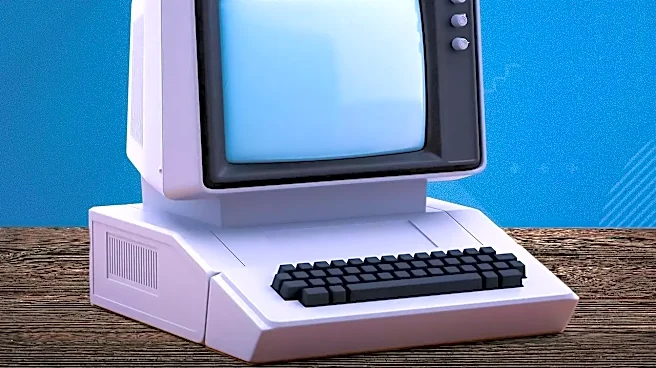
To understand why two letters mattered, you have to picture the world of computing in the late 1960s. Computers weren't personal devices; they were colossal, room-sized mainframes owned by universities,
corporations, and the government. These machines were powerful but profoundly isolated. They were islands of information, incapable of speaking to one another. Sharing data meant physically transporting magnetic tapes from one location to another. The U.S. Department of Defense's Advanced Research Projects Agency (ARPA) saw this as a strategic weakness. They envisioned a decentralized network that could allow researchers across the country to share resources and maintain communication, even if parts of the network were compromised. This radical idea was called ARPANET, and its goal was to turn these digital islands into a connected continent.
The Night of 'LO'
The scene was a UCLA computer lab on October 29, 1969. Professor Leonard Kleinrock and his student programmer, Charley Kline, were about to make history. Their goal was to log in remotely from their SDS Sigma 7 computer to a machine hundreds of miles away at the Stanford Research Institute (SRI), where programmer Bill Duvall was waiting. They had a telephone headset connection to talk each other through the process. Kline began to type the five letters of the command to access the remote system: 'LOGIN'. He typed 'L'. Over the phone, Duvall confirmed, "Got the L." Kline typed 'O'. "Got the O," Duvall said. Then, Kline typed 'G'. The system at SRI crashed. The first message ever sent across a computer network wasn't a grand proclamation. It was an unceremonious, two-letter fragment: 'LO'.
From Failure to Foundation
It would be easy to dismiss the moment as a comical failure. But in that glitch was a monumental success. For the first time, information had been sent from a host computer, broken down into packets, transmitted over a network, and received by another host computer hundreds of miles away. The crash was just a bug in the fledgling software. About an hour later, the team tried again and successfully completed the full 'LOGIN' command. But those first two letters, 'LO'—as in "lo and behold," Kleinrock would later joke—were the proof of concept. It demonstrated that packet-switching, the foundational technology of the internet that breaks data into small pieces for transmission, actually worked. This wasn't just about making two computers talk; it was about creating a new language for all computers to speak.
The Seeds of a Digital Nation
The ARPANET grew quickly from there. By the end of 1969, it connected four university nodes. Over the next decade, it expanded, and crucial protocols like TCP/IP were developed to standardize communication. Yet, for years, it remained the domain of academics and government researchers. What started with 'LO' laid the quiet groundwork for everything that would follow. It was the direct ancestor of the system that would eventually enable email, the World Wide Web, e-commerce, social media, and the entire digital economy. Every online purchase, every video call, and every search query is a direct descendant of that halting, two-letter transmission. The initial goal of resource sharing among scientists inadvertently sparked a communications revolution that completely reshaped American business, culture, and daily existence.