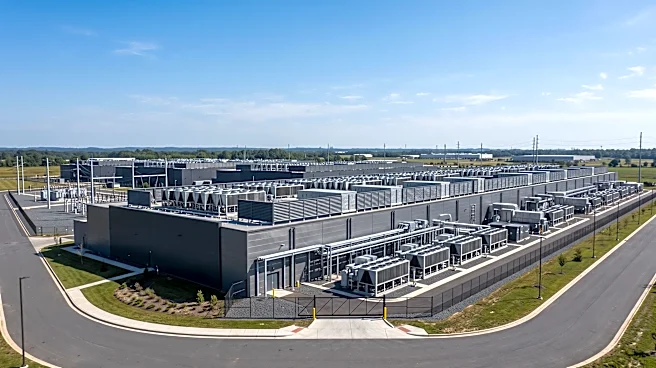









The AI revolution runs on electricity, and a colossal amount of it. As companies race to build powerful AI clusters, data center architects are quietly solving a crisis of power and heat that could halt progress in its tracks.
The Old Rules No Longer Apply
For years, data center design
followed a predictable path. A standard server rack, the tall metal frame that holds computing hardware, would consume about 5 to 10 kilowatts (kW) of power. Architects designed entire buildings around this assumption, using well-understood air conditioning techniques to keep everything from overheating. Then came the AI boom. The specialized, high-performance graphics processing units (GPUs) that are essential for training AI models are incredibly power-hungry. Suddenly, the old rules of power density—the amount of power consumed in a given physical space—were obsolete. A single rack designed for AI can now pull 50 kW, 100 kW, or even more, a 10- to 20-fold increase from the same footprint. This isn't just an incremental change; it's a structural redesign of how data centers must operate.
The AI Power Hunger Games
To understand the challenge, you have to understand the hardware. Traditional computing relied on central processing units (CPUs), the versatile workhorses of the digital age. But AI workloads, especially deep learning, are different. They involve performing millions of repetitive calculations in parallel, a task for which GPUs are uniquely suited. While a server CPU might draw a few hundred watts, a single high-end GPU can consume 700 to 1,200 watts on its own. A typical AI server packs eight of these GPUs, pushing the power draw for one machine to over 10 kW. An entire rack filled with these servers can easily exceed 100 kW. This concentration of power creates a thermal problem on an entirely new scale. All that electricity going into the chips comes out as heat, and if you can't remove it fast enough, the hardware will fail.
The Cooling Conundrum
The go-to solution for data center cooling has always been air. Massive computer room air conditioners (CRACs) would chill air and blow it under a raised floor, up through perforated tiles, and into the fronts of the server racks. This method is effective for racks drawing up to around 20 kW. But for AI's high-density racks, which can generate heat equivalent to dozens of home furnaces, air cooling is simply not enough. This has forced architects to embrace a solution once considered niche: liquid cooling. Because liquid is far more effective at transferring heat than air, it can handle the intense thermal loads of GPU clusters. Solutions range from direct-to-chip cooling, where liquid is piped directly to the hottest components, to fully immersive systems where entire servers are submerged in a non-conductive fluid. Adopting liquid cooling is a complex and expensive overhaul, but it has become a prerequisite for running AI at scale.
Straining the Nation's Grid
The problem extends far beyond the four walls of the data center. The sheer amount of electricity required by largescale AI facilities is straining local and regional power grids. A single large AI data center campus can consume hundreds of megawatts, enough to power a small city. This has created a bottleneck where securing enough power from utilities can take years, often longer than building the facility itself. Data centers are now projected to drive nearly half of all electricity demand growth in the U.S. through 2030, a surge that grid planners never anticipated. This has led architects to become energy strategists, negotiating directly with power companies and even exploring onsite power generation, including natural gas turbines and, for the largest players, striking deals for nuclear power to guarantee a stable, massive, and constant supply of electricity.