







The Specialist in a World of Generalists
Think of a standard computer processor (CPU) as a versatile Swiss Army knife. It's designed to do a huge variety of tasks reasonably well, from running your operating system to managing spreadsheets. A Graphics Processing Unit (GPU) is more specialized,
like a set of power tools, great for handling thousands of repetitive tasks at once, which is why it excels at video game graphics and AI training. An Application-Specific Integrated Circuit, or ASIC, takes this a step further. It's not a toolset; it’s a single, custom-forged wrench built to turn one specific bolt, faster and more efficiently than any other tool on earth. An ASIC is a microchip hard-wired from the ground up to perform a single function with breathtaking speed and minimal power consumption. It trades the flexibility of a CPU or GPU for extreme optimization. Because it has no unnecessary components, it can pack its silicon with circuits dedicated to one job, whether that's routing internet traffic, mining cryptocurrency, or accelerating AI calculations.
Anatomy of a Workhorse
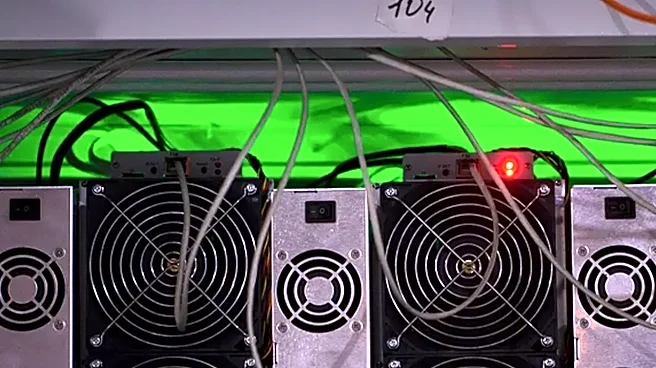
On its own, an ASIC is just a small, complex slice of silicon. Inside a production system like a data center server or a high-end network switch, it's the heart of a much larger operation. The chip itself is typically mounted on a circuit board, surrounded by everything it needs to function under intense pressure. This includes dedicated memory for temporarily storing data, power delivery circuits to feed its voracious appetite, and, crucially, substantial cooling systems. Because ASICs run at such high performance, they generate a tremendous amount of heat. In a server rack, you'll see them paired with large heatsinks and high-speed fans, or even integrated into liquid cooling loops, to keep temperatures stable. The entire assembly is designed for reliability and speed, as these systems often run 24/7. In a network switch, the ASIC is the core engine, processing and forwarding data packets at line-rate speeds—a task that a general-purpose CPU simply couldn't handle without creating a massive bottleneck.
Where the Rubber Meets the Road
You encounter the work of ASICs every day without realizing it. The two most significant production environments they dominate are networking and artificial intelligence. In telecommunications, ASICs are the backbone of the internet. Every time you stream a video or load a webpage, your data passes through routers and switches powered by ASICs designed specifically for managing high-speed data packets. They handle tasks like traffic management and security filtering with minimal delay, which is essential for a smooth online experience. The other major frontier is AI acceleration. Companies like Google, with its Tensor Processing Unit (TPU), and Amazon Web Services created custom ASICs to run their machine learning workloads more efficiently than even top-of-the-line GPUs. These AI-focused ASICs are built to handle the specific mathematical operations, like matrix multiplication, that are fundamental to training and running neural networks, driving everything from language models to image recognition.
The High-Stakes Trade-Off
If ASICs are so powerful, why isn't every chip an ASIC? The answer comes down to cost and flexibility. Designing and manufacturing a custom ASIC is an incredibly expensive and time-consuming process, often costing millions of dollars in non-recurring engineering (NRE) costs before a single chip is produced. This massive upfront investment only makes sense for applications that will be deployed at a very large scale, where the performance and power savings eventually pay for the initial outlay. Furthermore, their greatest strength is also their biggest weakness: they are completely inflexible. An ASIC designed for Bitcoin mining can't be repurposed to process video. Unlike an FPGA (Field-Programmable Gate Array), which can be reconfigured after manufacturing, an ASIC's logic is permanently etched into its silicon. This makes them a high-stakes bet for companies, who must be certain that the task they're designing for will remain relevant long enough to justify the investment.