





AMD's journey in the AI space is a masterclass in challenging a titan. Through strategic acquisitions and a commitment to open-source software, it has built a real alternative to Nvidia. If that David-vs-Goliath story resonates, here are five other companies
with equally compelling narratives.
1. Tenstorrent: The All-Star Architect's Open-Source Bet
If AMD’s story is about a company-wide comeback, Tenstorrent’s is about the power of a single, legendary architect. Helmed by Jim Keller—the mind behind AMD's own Zen processors and Apple's A-series chips—Tenstorrent is making a bold play centered on open standards. While Nvidia’s strength lies in its proprietary CUDA software, Tenstorrent is betting on the royalty-free RISC-V architecture and an open-source software stack. This strategy mirrors AMD's use of its ROCm software as an open alternative to CUDA. Keller's argument is you can't beat an incumbent by playing their game. By combining its AI accelerators with RISC-V CPUs and even licensing its IP to giants like Samsung and LG, Tenstorrent is building an entire ecosystem, not just a single chip. It's a high-risk, high-reward strategy that could fundamentally reprice enterprise AI.
2. Cerebras Systems: The 'Go Big or Go Home' Approach
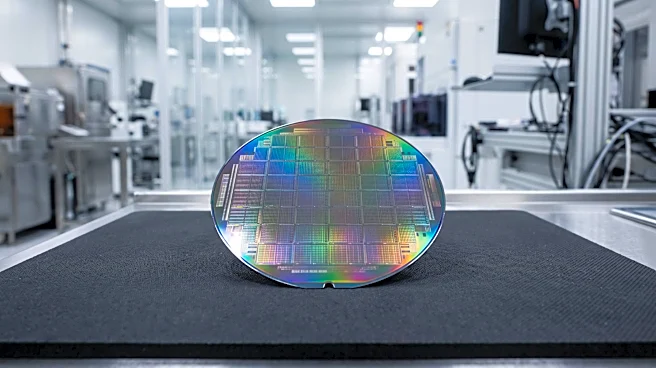
While most of the industry follows a path of connecting smaller chips together, Cerebras took the opposite approach: it builds one single, gigantic chip. Its Wafer-Scale Engine (WSE-3) is the largest processor ever made, a monolithic slab of silicon containing 900,000 AI-optimized cores and 4 trillion transistors. This audacious design solves a key problem in AI: communication latency between chips. By keeping everything on one massive die, data moves incredibly fast. The engineering challenges, from power delivery to managing manufacturing defects, are immense. Cerebras had to invent entirely new solutions for packaging and cooling. The story here is one of radical, first-principles thinking. It’s a bet that for the most demanding AI models, a completely different physical architecture is not just better, but necessary.
3. Groq: The Need for Speed Specialist
Groq’s story isn't about training massive models, but running them with unprecedented speed. The company has focused exclusively on AI inference—the process of generating a response—and has developed a novel chip architecture called the Language Processing Unit (LPU). Unlike GPUs, which are complex and can be unpredictable, the LPU is designed for deterministic execution. Think of it as a perfectly choreographed assembly line for data. A compiler schedules every single operation and data movement in advance, eliminating bottlenecks and delivering breathtakingly fast token generation. This software-first approach has allowed Groq to demonstrate speeds that leave traditional hardware in the dust for specific tasks. It’s a story of specialization, proving that a purpose-built solution can outperform a general-purpose tool in the right context.
4. SambaNova Systems: The Full-Service AI Platform
SambaNova’s narrative is less about the chip and more about the business model. While it designs its own powerful 'Reconfigurable Dataflow Unit' (RDU) processors, its key innovation is a 'Dataflow-as-a Service' offering. The company provides a fullstack, subscriptionbased platform that includes hardware and pretrained models, allowing enterprises to deploy AI without needing to become chiplevel experts. This strategy targets a major pain point for businesses that want the power of custom AI without the complexity of building and managing the underlying infrastructure. Founded by Stanford professors and an Oracle veteran, SambaNova's story is about abstracting away the hardware complexity entirely and selling results, not just processors. It’s a compelling alternative for organizations that want to focus on their data, not their data centers.
5. Graphcore: A Cautionary Tale of a Pioneer
Graphcore's story is fascinating for a different reason : it’s a lesson in how hard it is to compete. As one of the early, highflying challengers to Nvidia, Graphcore developed a unique Intelligence Processing Unit (IPU) with a massively parallel architecture and a dedicated software stack called Poplar. The design was clever, focusing on finegrained parallelism and onchip memory. For a time, it seemed like a leading contender, even striking a major deal with Microsoft. However, the company struggled to keep pace with the rapidly evolving AI landscape, particularly the rise of enormous language models, and faced commercial headwinds that led to a significant downround. Graphcore’s story serves as a crucial reality check. It highlights that brilliant engineering alone isn't enough ; timing, software maturity, and gotomarket strategy are just as critical in the brutal arena of AI hardware.