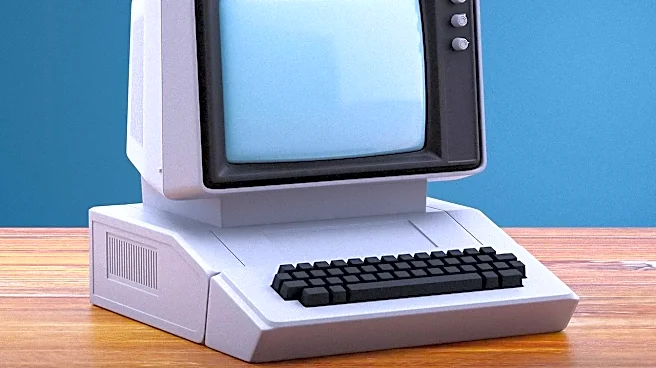

A World Without Pointers
It’s hard to imagine now, but computing in the mid-20th century was an intimidating, text-based affair. Users communicated with room-sized mainframes by typing cryptic commands or feeding them stacks of
punched cards. Computers were powerful calculators for specialists, not interactive tools for the masses. The screen was a place for output, not a space for direct manipulation. To make computers truly personal and collaborative, a bridge was needed between the physical world of the user and the digital world on the screen. Someone had to invent a way to point.
Engelbart’s Big Idea
That someone was Douglas Engelbart, a researcher at the Stanford Research Institute (SRI). Engelbart had a profound and then-radical vision: computers could be used to “augment human intellect.” He didn't just want to make machines faster; he wanted to make people smarter by creating a symbiotic relationship with technology. To achieve this, he needed a simple, intuitive way for a person to interact with information on a display. The idea for the mouse came to him in 1961, but it was in 1964 that the first prototype was built by his lead engineer, Bill English. It was a humble device carved from wood, with two perpendicular wheels on the bottom and a single red button on top. Engelbart's team officially called it an “X-Y Position Indicator for a Display System,” but the team nicknamed it a "mouse" because the cord trailing from the back looked like a tail, and the name stuck.
The Day the Future Arrived
The mouse, along with a suite of other revolutionary concepts, made its public debut on December 9, 1968, at a San Francisco computer conference. In a 90-minute presentation that would become legendary as “The Mother of All Demos,” Engelbart and his team, with Bill English directing the technical production, showcased a future no one else had even imagined. From his console, Engelbart used the mouse to manipulate text, click on hypertext links, resize windows, and engage in a shared-screen video conference with colleagues 30 miles away. He demonstrated, in real-time, the core components of modern personal computing. The audience was stunned, but the wider world wasn't ready. The ideas were so far ahead of their time that they remained largely confined to the lab, a brilliant preview of a future that would take decades to arrive.
The Long Road to the Desktop
The "quiet" reshaping of computing began when Engelbart's ideas—and some of his engineers, including Bill English—migrated from SRI to Xerox’s new Palo Alto Research Center (PARC) in the 1970s. At PARC, researchers refined the mouse and integrated it into the Xerox Alto, the first computer to feature a complete graphical user interface (GUI) with windows, icons, and menus. Yet, Xerox failed to successfully commercialize this breakthrough. The Alto was never sold as a commercial product, and its successor, the Xerox Star, was too expensive to find a market. The final leap happened in 1979, when a young Steve Jobs toured PARC. Apple arranged the visit as part of a deal allowing Xerox to invest in the company. Jobs immediately grasped the potential of the GUI and mouse. He didn't steal the idea; Apple licensed the technology and then, crucially, innovated on it. Apple’s engineers, commissioned to bring the cost down from hundreds of dollars to around $25, redesigned it into the iconic single-button device that launched with the Lisa and, most famously, the 1984 Macintosh. It was Apple that finally made Engelbart's vision accessible, affordable, and essential.