



First, What's a Regular 'Autoencoder'?
Imagine you have a complex novel. A standard autoencoder is like a two-person team with a very specific task. The first person, the 'encoder', reads the entire book and writes a super-condensed summary on a single index card. The second person, the 'decoder',
has never seen the book and must rewrite it using only the notes on that card. The goal is to make the rewritten book as close to the original as possible. In AI, this is used for tasks like data compression or removing 'noise' from an image. The encoder compresses a high-resolution image into a compact digital summary (called a latent space), and the decoder reconstructs it. It’s great for copying, but it has a fatal flaw: you can't use it to create anything new. The summaries are so specific that if you try to write a new, random summary card, the decoder will just produce gibberish.
The 'Variational' Leap: From a Point to a Possibility
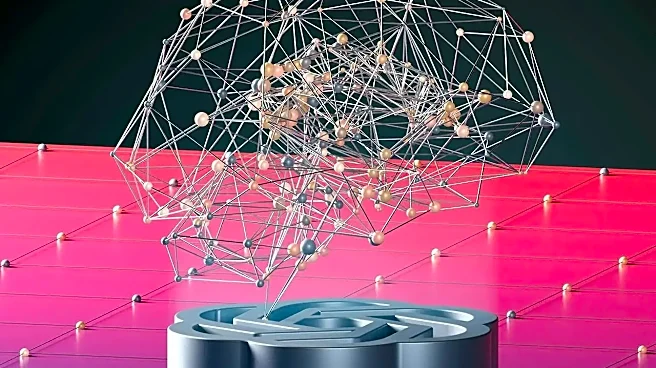
This is where the 'variational' part, introduced in a landmark 2013 paper by Diederik Kingma and Max Welling, changes the game. A Variational Autoencoder doesn't summarize the input to a single, rigid point. Instead, it describes a 'region of possibility'—a fuzzy cloud in its internal map of concepts. Rather than saying, 'This exact summary describes this exact cat', a VAE says, 'Images that look like this cat exist in this general neighborhood of my cat map'. The encoder produces not a fixed summary, but a probability distribution—essentially a center point and a radius of uncertainty. This intentional 'blurriness' forces the model to make its conceptual map smooth and continuous, without the empty gaps that plagued older autoencoders.
The Power of a Smooth 'Map' of Ideas
Because a VAE’s internal 'latent space' is a continuous map of features, it becomes explorable. You can pick a point on the map between 'person with glasses' and 'person without glasses', and the decoder can generate a coherent face that blends those two attributes. It’s no longer just a copy machine; it’s a creative engine. This ability to sample from the learned distribution allows VAEs to generate entirely new data points that are similar to, but not identical to, what they were trained on. This was a fundamental shift from merely reconstructing data to generating it, paving the way for AI that could create novel images, synthesize speech, or even help design new drug molecules.
The Unsung Hero Behind Modern AI
While VAEs were being developed, another type of generative model, the Generative Adversarial Network (GAN), often stole the show for its ability to produce hyper-realistic, sharp images. GANs work by pitting two networks against each other—a generator and a discriminator—in a constant duel. But VAEs offered a more elegant, probabilistic foundation. Their real legacy is not just in the images they produce, but in the concepts they proved. The idea of a structured, continuous latent space became a core principle in AI. In fact, many modern, powerful models like Stable Diffusion still use a VAE-like component to handle the final step of generating an image, proving the enduring utility of this 'quiet' innovation. Beyond image generation, VAEs are critical tools for anomaly detection in manufacturing and medicine, identifying when something deviates from the learned norm.