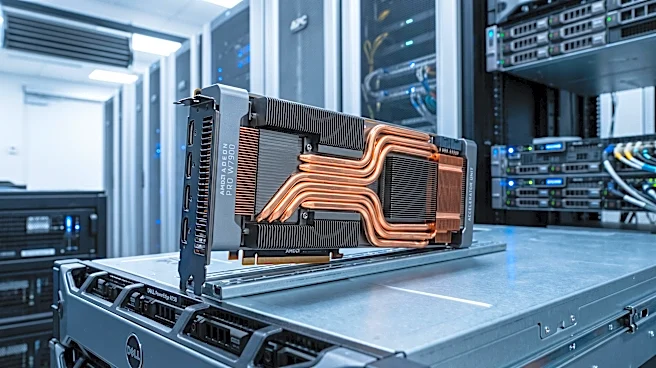









The artificial intelligence boom has been fueled by one critical component: the powerful graphics processing unit (GPU). But as tech giants like Meta race for AI supremacy, they're starting to build their own tools for the job.
The Undisputed Reign of the GPU
For the last several years,
the AI gold rush has had one clear winner in the hardware department: Nvidia. The company’s powerful GPUs became the default engine for training and running the complex AI models that have captured the world's attention. Nvidia's dominance is staggering, with some estimates putting its market share for AI chips at over 85-90%. This is due not only to powerful hardware but also to its mature CUDA software platform, which has become the industry standard for AI development. However, this dominance comes at a price—literally. High-end GPUs are expensive, and for 'hyperscale' companies like Meta that operate massive data centers, the cost of buying hundreds of thousands of these chips runs into the tens of billions of dollars. This has created a strategic vulnerability: a dependency on a single supplier for the most critical component of the AI future.
Meta's Answer: The MTIA Chip
In response, Meta has been aggressively developing its own family of custom chips, known as the Meta Training and Inference Accelerator (MTIA). The first versions were announced in 2023, and the company is now on an ambitious roadmap to release four new generations within two years. Unlike a general-purpose GPU, the MTIA is an Application-Specific Integrated Circuit (ASIC). Think of a GPU as a versatile, powerful wrench set that can handle almost any job, while an ASIC is a custom-forged tool designed to do one specific job with maximum efficiency. Meta's chips are explicitly designed to accelerate the exact workloads that dominate its platforms, such as the ranking and recommendation algorithms for Facebook and Instagram, and increasingly, generative AI tasks.
The Strategic Calculus: Cost, Control, and Customization
The decision to invest billions in designing chips is driven by a clear-headed business strategy. First and foremost is cost. While the upfront investment in chip design is enormous, the long-term savings from producing custom silicon at scale can be massive, especially compared to paying another company's high margins. Second is control. The AI boom has led to supply shortages and long wait times for top-tier GPUs, creating a bottleneck for innovation. By designing its own chips and working directly with manufacturers like TSMC, Meta can better control its supply chain and insulate its AI roadmap from external market pressures. Finally, there's customization. A generic GPU is not perfectly optimized for any single task. Meta can design its MTIA chips to be exceptionally efficient at the precise calculations its AI models need, leading to better performance and, critically, lower energy consumption—a huge factor in running data centers at planetary scale.
An Industry-Wide Power Play
Meta is not alone in this endeavor. In fact, it's part of a broader trend among the tech giants, who are all the biggest customers of Nvidia. Google was a pioneer in this space with its Tensor Processing Units (TPUs), which have been running its search and AI workloads for years. Amazon has its Trainium and Inferentia chips for its AWS cloud platform, and Microsoft has developed its own chip called Maia. This collective move signals a fundamental restructuring of the AI hardware market. It's a strategic declaration from the world's largest tech companies that they cannot afford to have their core business dependent on a single external supplier. While they will all continue to buy GPUs in massive quantities, they are simultaneously building an alternative path to ensure they dictate the terms of their own technological future.