


Nvidia: Powering the AI Universe
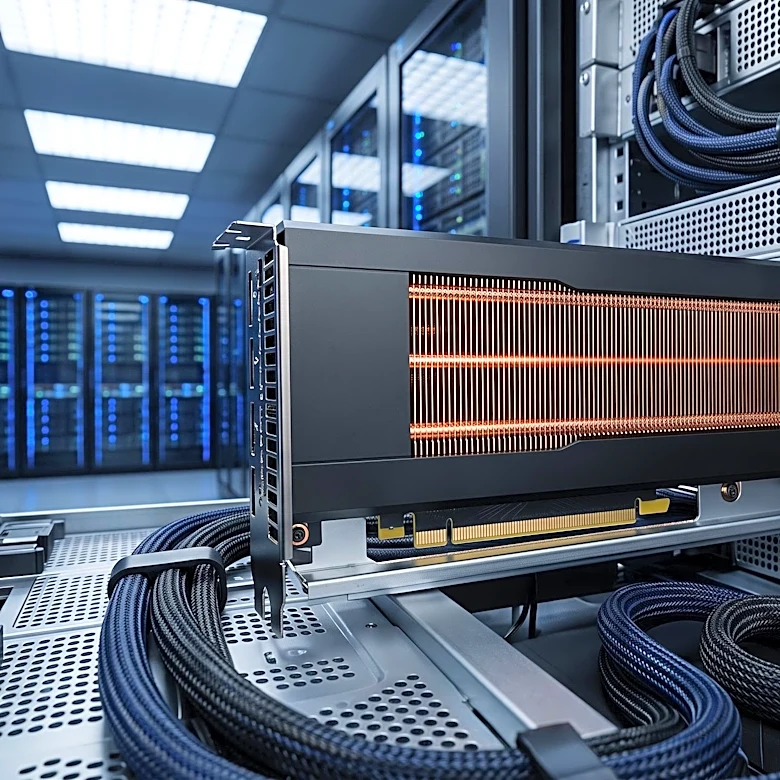
If the AI boom is a gold rush, Nvidia is selling the picks, shovels, and heavy machinery to every miner on the planet. The company’s strategy is centered on its dominance in the data center, where its powerful graphics processing units (GPUs) have become
the undisputed engine for training and running large-scale AI models. Companies from OpenAI and Microsoft to Google and Meta rely on thousands of Nvidia’s chips, like the H100 and its newer Blackwell and Rubin series, to power services like ChatGPT and enterprise AI infrastructure.Nvidia’s business model is to be a full-stack platform. It doesn't just sell silicon; it provides a comprehensive and deeply entrenched software ecosystem called CUDA. For years, developers have built AI applications using CUDA, creating a powerful lock-in effect that makes it difficult for competitors to gain ground, even with comparable hardware. This strategy has made Nvidia the backbone of the cloud-based AI world, selling the raw computational power that fuels the entire industry.
Apple: Weaving AI into Your Daily Life
Apple is playing a completely different game. It isn't trying to sell AI infrastructure to other companies; it wants to make the devices you already own more intelligent, useful, and personal. Its strategy is built around on-device AI, where processing happens directly on your iPhone, Mac, or iPad. This is made possible by Apple Silicon—its custom M-series chips that integrate a powerful CPU, GPU, and a specialized 'Neural Engine' designed for AI tasks.By keeping AI processing local, Apple emphasizes speed, efficiency, and, most importantly, privacy. Your personal data doesn't need to be sent to a server in the cloud for most AI features, a key selling point in a privacy-conscious world. Rather than building a better chatbot to compete with ChatGPT, Apple is embedding 'Apple Intelligence' quietly into its operating systems to improve photos, summarize text, and make Siri more capable. For Apple, AI isn't a product you buy; it's an invisible enhancement to the products you already have.
Two Philosophies: Open vs. Integrated
The core difference in their approaches comes down to their business philosophies. Nvidia thrives on being a component in an open ecosystem. It provides the essential hardware and software platform that enables thousands of other companies to innovate on top of it. Its success depends on being the best tool for the job, no matter who the customer is.Apple, true to form, operates a vertically integrated, closed ecosystem. It controls the hardware (the silicon), the software (iOS and macOS), and the services built on them. This allows for tight optimization between hardware and software, delivering a seamless user experience. The M-series chip's unified memory architecture, for instance, allows it to handle very large AI models on a consumer device—a task that would choke many high-end PC GPUs. While Nvidia is focused on raw power for the cloud, Apple focuses on silent, power-efficient performance for the device in your hand.
Collision Course or Different Lanes?
For now, Nvidia and Apple largely operate in separate spheres. Nvidia sells to enterprises and cloud providers, while Apple sells to consumers. But the lines are beginning to blur. As on-device AI becomes more powerful, it reduces the need for some tasks to be sent to the cloud, which could theoretically chip away at the need for massive data centers. Apple is even pitching its high-end Mac Studio desktops as cost-effective alternatives to renting cloud servers for certain AI development tasks.However, a full-scale collision seems unlikely. Training the next generation of massive AI models will always require the immense power that only data centers full of Nvidia GPUs can provide. The more likely future is a hybrid one, where simple, private tasks run on your Apple device, and more complex queries are seamlessly offloaded to the cloud—which will almost certainly be running on Nvidia hardware. They aren't so much direct rivals as two giants building different, but equally critical, halves of our AI-powered future.