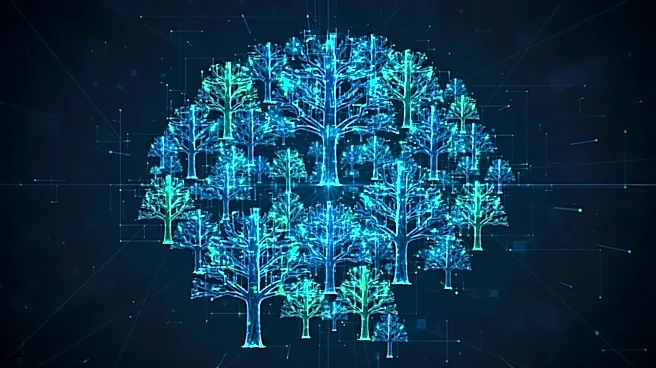










Answering a Question with a Crowd
So, what is a random forest? Imagine you need to make a tough decision, so you ask an expert. That single expert, however smart, might have biases or blind spots. Now, imagine you ask a huge crowd of reasonably informed people the same question and take
the most common answer. The collective wisdom of the crowd is often more accurate than any single expert. That's the core idea behind random forests. The algorithm doesn't build one massive, complicated model. Instead, it builds hundreds or even thousands of simple models called "decision trees." A single decision tree is just a flowchart of yes/no questions, but it can be prone to errors or memorizing noise in the data. A random forest combines all these simple trees—the "forest"—and has them vote on the final prediction. For classification tasks, the winning vote is the answer; for numerical predictions, it's the average.
The Genius of 'Randomness'
The secret sauce, as the name suggests, is randomness. The algorithm, developed and formalized by Leo Breiman in 2001, introduces randomness in two clever ways. First, each tree in the forest is shown only a random sample of the original data, a technique called bagging. This ensures the trees are diverse. Second, at each branching point within a tree, it's only allowed to consider a random subset of features. This prevents a few dominant features from controlling every tree's decision. This dual-layered randomness is crucial. It creates a forest of "uncorrelated" trees, meaning they don't all make the same mistakes. This process dramatically reduces the risk of "overfitting," a common problem where a model learns its training data so well it fails on new, unseen data. The result is a final model that is incredibly robust and accurate.
The Unsung Hero of Your Daily Life
While you might not have heard of them, random forests are working behind the scenes in countless applications you use every day. In finance, they are a workhorse for detecting fraudulent credit card transactions and assessing which loan applicants are likely to repay on time. In healthcare and biology, they help doctors diagnose diseases by analyzing patient data and help researchers identify important genetic markers. E-commerce sites use them for product recommendations and to predict customer behavior. The algorithm's ability to handle messy, incomplete data with many variables makes it exceptionally versatile and powerful for these real-world problems. It's a testament to its effectiveness that even with the rise of deep learning, it remains a go-to tool.
A Foundation, Not a Relic
In a world dominated by headlines about large language models and neural networks, it's easy to dismiss a 20-year-old algorithm. But that would be a mistake. While deep learning excels at complex tasks like image recognition, random forests are often faster, less computationally expensive, and easier to implement for many common business problems, especially those involving structured, tabular data (think spreadsheets). They require less data and tuning than neural networks and are more interpretable, allowing data scientists to understand which factors were most important in a prediction. Far from being obsolete, random forests are still a vital part of the modern AI toolkit, often used as a powerful baseline to beat or as a component in larger automated systems. It stands as a powerful reminder that in the world of technology, the most hyped solution isn't always the one getting the most work done.