









The Old Guard: Nuance and Vanishing Returns
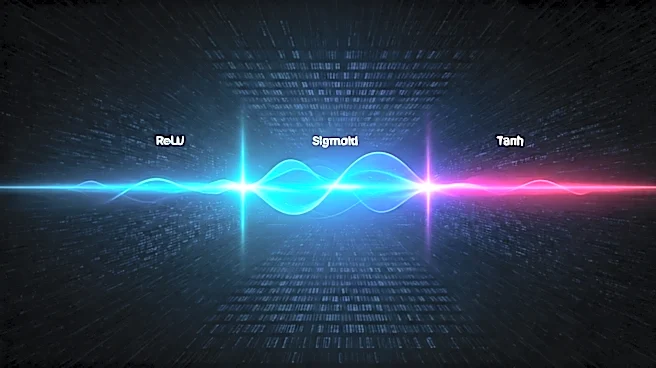
Let’s start with sigmoid and tanh. For years, these were the stars of the artificial intelligence world. Think of them as the “thoughtful deliberators” inside a neural network, the AI’s brain. Both functions take any input number, no matter how large
or small, and gently squash it into a neat, predictable range. Sigmoid maps everything to a value between 0 and 1, like converting a complex reality into a simple probability. Tanh does the same, but to a range between -1 and 1. Their defining feature is their smooth, S-shaped curve. This mathematical elegance represented a desire for nuance. A small change in input led to a small, proportional change in output. It felt organic, like a measured response. But this very elegance was their downfall. When building the massive, deep neural networks that power today’s AI, this gentle squashing created a problem called the “vanishing gradient.” In simple terms, as information passed through many layers of the network, the learning signal got weaker and weaker, until the AI essentially stopped learning. They were too thoughtful for their own good, getting lost in the weeds and failing to make progress on truly complex problems.
The Disruptor: The Age of the On/Off Switch
Enter ReLU, which stands for Rectified Linear Unit. Compared to the smooth curves of its predecessors, ReLU is brutally simple. Its rule is: if the input is positive, let it pass through unchanged. If it’s negative, the output is zero. That’s it. It’s not a gentle curve; it’s a sharp, angular hinge. On paper, it sounds almost stupidly basic. But this simplicity was revolutionary. By simply turning off negative values, ReLU didn't suffer from the same vanishing gradient problem. Information could flow through deep networks without fading away. This unlocked the ability to train networks with dozens, even hundreds, of layers—the “deep learning” that powers everything from your phone’s camera to ChatGPT. ReLU is the workhorse, the pragmatist. It’s computationally cheap, fast, and effective. It doesn't get bogged down in nuance; it just works, allowing for unprecedented scale. Its philosophy is less about perfect representation and more about relentless, forward momentum.
A Tale of Two Philosophies
The shift from sigmoid/tanh to ReLU isn't just a technical upgrade; it’s a philosophical one. The earlier functions represent a belief in moderation, nuance, and bounded systems. They operate on the assumption that the world should be carefully mapped into a known, finite space. They are cautious, deliberative, and ultimately, limited by their own carefulness. ReLU represents a different worldview entirely: a belief in unbounded potential and ruthless efficiency. Its logic is that of radical simplicity and scale. If something is working (a positive signal), do more of it, infinitely. If it’s not (a negative signal), ignore it completely. There is no middle ground, no gentle tapering. This binary, all-or-nothing approach is what enabled AI to break through its previous limitations and achieve the spectacular, sometimes unsettling, capabilities we see today. It’s the triumph of brute-force computation over elegant, but slow, deliberation.
So, What's the Prediction?
This brings us to the next decade. The dominance of ReLU’s philosophy predicts a future defined by scale and efficiency above all else. We will see technology, particularly AI, advance through bigger models, bigger datasets, and more raw computing power. The prevailing strategy will be the ReLU strategy: find a simple mechanism that works and scale it to an astonishing degree. This is the path of Large Language Models and massive generative AI, which achieve their magic not through a new, nuanced understanding of the world, but through the brute-force pattern-matching of a ReLU-powered system scaled to planetary size. However, the ghost of sigmoid and tanh still haunts the field. It represents the persistent search for something more—for AI that has genuine understanding, that can reason with nuance, that operates with the energy efficiency and subtlety of a biological brain. The prediction, then, is not a single outcome but a persistent tension. The next decade will be dominated by the fruits of ReLU’s brute-force paradigm, but the most important breakthroughs may come from those who, inspired by the limitations of this approach, finally figure out how to build something with the nuance of sigmoid but the power to truly scale.