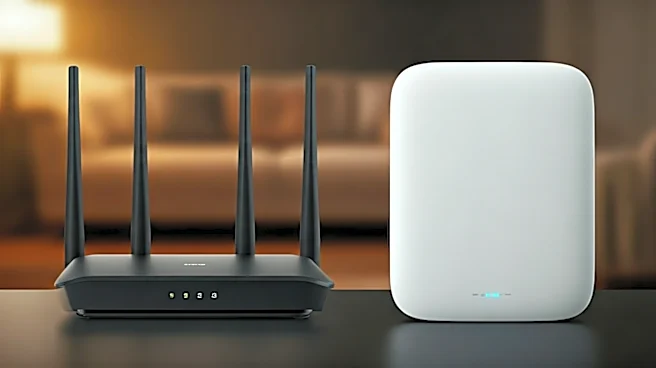








The Fortress: The Traditional Router
Think of a traditional router as a fortress with a single, powerful watchtower. Its design philosophy is all about centralized power. It’s built to blast a Wi-Fi signal out from one location, covering as much ground as possible. The 'real reason' for this design is rooted in a simpler internet era, where a single desktop computer in a home office was the primary concern. To keep up with modern demands, manufacturers have armed these fortresses with more antennas, more processing power, and technologies like beamforming, which intelligently focuses the signal toward your devices. For a smaller apartment or a single-story home with an open floor plan, this can be an incredibly effective and cost-efficient solution. A high-end traditional router can deliver
phenomenal speeds, but its power diminishes with every wall, floor, and appliance it has to penetrate. The signal gets weaker the farther you are from the tower, creating the dreaded 'dead zones' in basements, back bedrooms, or patios.
The Team: The Mesh Wi-Fi System
A mesh system takes the opposite approach. Instead of one powerful fortress, it’s a team of smaller, cooperative units. The main unit, or 'node,' connects to your modem, and several satellite nodes are placed strategically around your home. Its design philosophy is all about coverage and consistency. The 'real reason' mesh was developed was to solve the dead zone problem that fortresses create in larger, more complex homes. These nodes create a single, unified network that blankets your entire property. The magic is in the 'backhaul'—a dedicated, high-speed channel the nodes use to talk to each other. This ensures that even a node far from the modem can deliver a strong, fast signal because it’s getting a clean hand-off from a closer teammate. This design prioritizes eliminating weak spots over achieving the absolute maximum speed at a single point. It's built for homes where people are streaming, gaming, and working in multiple rooms at once.
The 4K Streaming Gauntlet
Now, let’s apply this to the ultimate test: a 4K streaming household. Streaming a 4K movie requires not just speed, but *consistent* speed. Netflix recommends a steady 15-25 Mbps connection per 4K stream. If you have a family, you might have multiple 4K streams running simultaneously on different TVs, plus phones and laptops competing for bandwidth. This is where the design philosophies really matter. A traditional router might deliver a blazing 500 Mbps when you’re standing next to it, but that could drop to a stuttering 10 Mbps in the upstairs bedroom, causing your 4K stream to buffer or downgrade to HD. The fortress’s signal simply can't hold up against the distance and obstacles. A mesh system, however, was born for this. The node in that upstairs bedroom ensures the TV gets a strong, steady signal, relayed from the main unit via another node in the hallway. You might not get the absolute peak speed of a top-tier traditional router in any one spot, but you will get a reliably fast connection *everywhere*, which is far more important for an uninterrupted 4K experience.
Making the Right Call for Your Home
So, which design is right for you? It's not about one being universally 'better.' It’s about matching the technology's core purpose to your living situation. You should choose a traditional router if: you live in a smaller home or apartment (under 1,500 sq. ft.), your layout is relatively open, and you prefer to have a single, highly configurable device. Tech-savvy users who enjoy tweaking settings for maximum performance often prefer this route. You should choose a mesh system if: you live in a larger home (over 2,000 sq. ft.), have multiple floors, brick walls, or an unusual layout that creates dead zones. If you have a large family with multiple devices all competing for Wi-Fi and you prioritize simple setup and consistent coverage over everything else, mesh is the clear winner for a stress-free streaming life.