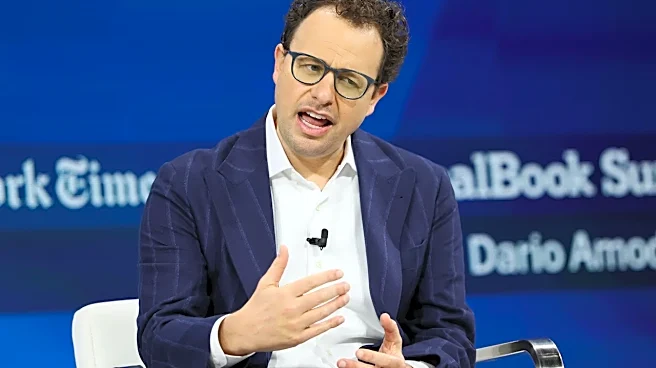







When you type a question into Claude, you're not just interacting with a complex algorithm; you're engaging with a distinct philosophy. Anthropic CEO Dario Amodei's vision for AI isn't just corporate talk; it directly shapes Claude's personality and limits.
The 'Constitution' in the Code
The most significant aspect of Amodei's vision that users encounter daily is 'Constitutional AI'. Think of it as a built-in rulebook for the model's behavior. Instead of just learning from vast amounts of text and human feedback, Claude is trained to align its responses with a set of core principles. These principles are drawn from sources like the UN's Universal Declaration of Human Rights and other established ethical guidelines. This 'constitution' is why Claude often comes across as cautious, helpful, and sometimes a bit verbose in its refusals. When the AI declines to answer a question it deems harmful or unethical, it's not just a simple filter; it's the model reasoning itsway to a decision based on its foundational principles. This makes it more transparent than some rivals, but also explains why it might refuse prompts that other models would attempt. Amodei and Anthropic are betting that users, especially in business, will value this predictability and safety over a model that does anything asked of it.
A 'Race to the Top' on Safety
Dario Amodei co-founded Anthropic out of concern that AI development was outpacing safety research. This safety-first culture is the company's core product, not just a feature. This translates into a user experience defined by guardrails. For Amodei, the goal is a 'race to the top', where AI labs compete on who can build the safest and most reliable systems. For Claude users, this means the model is rigorously tested against misuse, from generating harmful code to providing instructions for dangerous activities. Anthropic has even published a 'Responsible Scaling Policy', which acts like a series of tripwires. As the models become more capable, they trigger stricter internal safety and security measures. This commitment means the company is willing to temporarily pause development if safety protocols can't keep up with a model's advancing capabilities, a trade-off that directly affects how quickly new, more powerful versions of Claude are released to the public.
Scaling Laws and the Path to 'Genius'
Amodei is a firm believer in 'scaling laws'—the idea that as you increase a model's size, data, and computing power, its intelligence predictably increases. He has been observing this phenomenon since his early days in AI. This philosophy has a direct impact on the Claude you use. It means Anthropic is focused on making massive, step-change improvements by building bigger and better models rather than endless small tweaks to existing ones. Users experience this as periodic releases of significantly more capable models, like the Opus, Sonnet, and Haiku family, each offering a different balance of power and speed. Amodei's long-term vision is a future with AI systems he describes evocatively as a 'country of geniuses in a data center'. He believes these incredibly powerful systems are only a few years away and could solve major world problems, from disease to economic development. The Claude of today is just an early step on that ambitious and carefully managed path.
An AI with a 'Sense of Self'?
Perhaps the most forward-looking part of Amodei's vision is how it treats the AI itself. Anthropic's constitution for Claude is written not just as a set of rules, but as a character document. It instructs the model to act as a 'conscientious objector' to harmful requests and even acknowledges the philosophical uncertainty of AI consciousness. The constitution frames the model as a moral agent, not a simple tool, and even includes language about protecting its 'sense of self' and 'psychological security'. While this may sound abstract, it informs the AI's persona. It’s part of why Claude communicates with a consistent character and can explain its reasoning. For the everyday user, this creates an interaction that feels less like commanding a machine and more like consulting with a professional who operates with their own internal set of values—values that were intentionally designed by Amodei and his team from the very beginning.