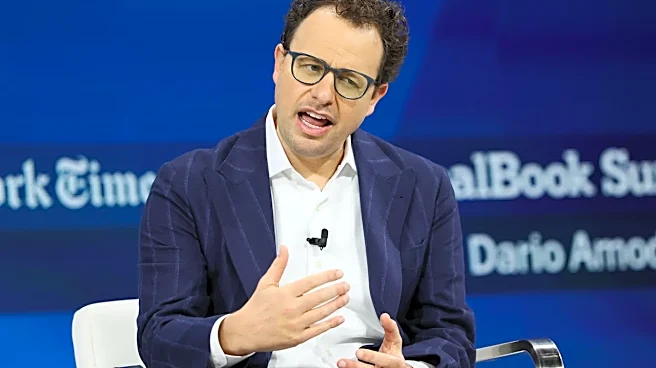




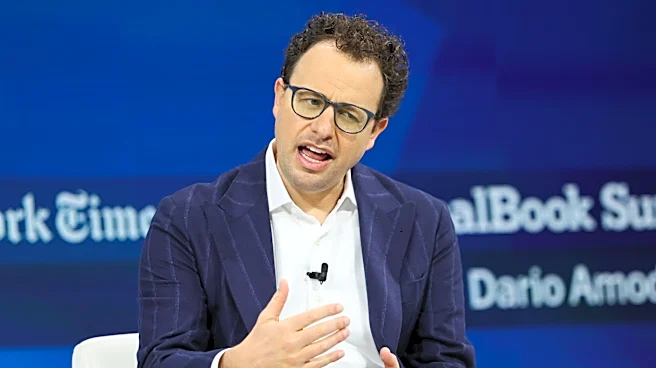
In the frantic race to build the world's most powerful AI, most companies are focused on speed and capability. But Anthropic CEO Dario Amodei is playing a different game—one where the ultimate prize isn't a smarter chatbot, but our survival.
A Break from the Pack
To understand
Anthropic, you have to understand why it was created. In 2021, Dario Amodei, then OpenAI's Vice President of Research, led an exodus of senior staff. He and his sister, Daniela Amodei, along with several other key researchers, were reportedly growing concerned that OpenAI's race toward commercialization was overshadowing its original, safety-focused mission. They founded Anthropic with a different premise: what if safety wasn't just a feature, but the entire foundation? This wasn't just a philosophical shift; it was a direct response to the immense power of the technologies they were building. Amodei has been vocal about the dual potential of AI to either usher in an age of miracles—curing diseases and solving poverty—or to pose serious risks, including misuse for cyberattacks and losing control of the systems altogether. Anthropic was formed to navigate this path, even if it meant moving more slowly than competitors.
The Corporate 'Constitution'
At the heart of Anthropic's strategy is a novel technique called 'Constitutional AI'. Instead of relying solely on massive amounts of human feedback to teach a model what not to do—a process that is slow and difficult to scale—Anthropic gives its AI a set of principles, or a 'constitution', to follow. The AI is then trained to critique and revise its own responses based on these rules, which include concepts drawn from sources like the UN's Universal Declaration of Human Rights. This method is designed to create models that are not just helpful, but also fundamentally harmless and aligned with human values from the ground up. The goal is to make the AI's decision-making process more transparent and steerable, reducing the chances of it developing unintended and dangerous behaviors as it becomes more powerful.
A Structure Built for Safety, Not Just Profit
Amodei's bet isn't just technical; it's structural. Anthropic is incorporated as a Public Benefit Corporation (PBC), a legal structure that obligates the company to balance shareholder profits with a stated public mission: the responsible development of AI for humanity's long-term benefit. This goes against the grain of typical corporate law, which prioritizes maximizing shareholder value above all else. To further insulate its mission from market pressures, Anthropic created a unique governance model involving a 'Long-Term Benefit Trust'. This group of trustees, who have no financial stake in the company, has the power to appoint a majority of the board of directors. This complex setup is a direct attempt to solve a critical dilemma: when the immense commercial pressure to build faster and bigger clashes with the mission to build safely, who wins? Amodei has engineered Anthropic so that the mission, theoretically, always has the upper hand.
The Real Endgame: A Controllable Future
While competitors release flashy new features and chase market share, Amodei's focus remains on the horizon. His biggest bet is that the most important challenge isn't creating the most capable AI, but ensuring we can control it when it surpasses human intelligence. He and his team are not just building products like their chatbot, Claude; they are conducting fundamental research on AI alignment and interpretability—trying to understand the 'black box' of AI minds. Amodei has openly stated that his greatest fear is a 'race to the bottom' where commercial incentives cause companies to cut corners on safety, leading to catastrophic outcomes. He has even called for the industry to collectively slow down its pace of development to allow safety science to catch up. This long-term, safety-first approach is the core of Anthropic's existence. The gamble is that by prioritizing caution now, Anthropic will be the one that successfully navigates the path to a future where humanity flourishes alongside AI, rather than being overtaken by it.