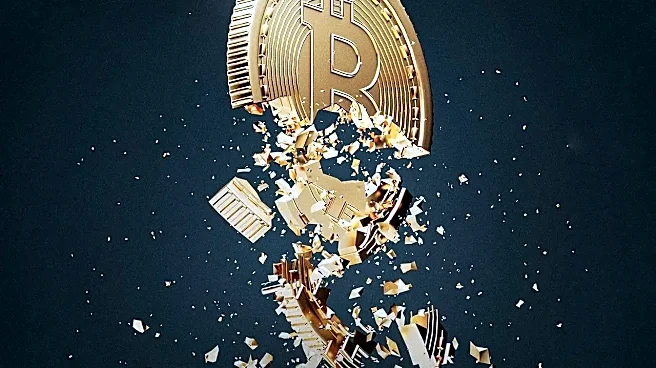






In May 2022, a 'stablecoin' called TerraUSD (UST) and its sister token, Luna, imploded, wiping out an estimated $45 billion and triggering a crypto market meltdown. How did an asset designed to be worth exactly $1 fall to zero?
The Alluring 'Stable' Promise
First, let's talk about
what a stablecoin is supposed to do. Unlike notoriously volatile cryptocurrencies like Bitcoin, stablecoins are designed to hold a steady value, usually pegged to a real-world currency like the U.S. dollar. Most major stablecoins, like USDC or Tether, achieve this by holding actual dollars or equivalent assets in a reserve. For every digital token in circulation, there is (supposedly) a dollar in a bank account somewhere. TerraUSD, or UST, was different. It was an 'algorithmic' stablecoin, meaning it wasn't backed by cash reserves. Instead, it used a clever, automated relationship with its sister token, Luna, to maintain its $1 peg. The pitch was seductive: a decentralized, stable dollar that didn't rely on old-school banks. For many, this seemed like the next evolutionary step in finance.
An Engine Designed for a Death Spiral
So, how did the algorithm work? In theory, it was a simple arbitrage game. The system always allowed a user to swap 1 UST for $1 worth of Luna, and vice versa. If UST’s price dipped to $0.99, traders could buy the cheap UST and swap it for $1 worth of Luna, pocketing a penny and pushing UST's price back up. If UST went to $1.01, they could do the reverse. This mint-and-burn mechanism was meant to keep the price stable. The critical flaw was that this entire system was propped up by faith in the value of Luna. The stability of the 'stable' coin depended entirely on a separate, highly volatile cryptocurrency. If confidence in Luna evaporated, the algorithm that was supposed to maintain the peg would instead accelerate its collapse—a 'death spiral' where printing more Luna to save UST would only crash Luna's price further, making the situation worse.
The Bait: An Unsustainable 20% Yield
If the mechanics were so fragile, why did billions pour in? The answer lies with the Anchor Protocol, a lending and borrowing platform built on Terra. Anchor offered an almost unbelievable deal: deposit your UST and earn a consistent 20% annual percentage yield (APY). In a world where traditional savings accounts offer less than 1%, this was an irresistible lure. This high yield created massive, artificial demand for UST, as investors flocked to get what they saw as high, safe returns on a 'stable' asset. But the yield was completely unsustainable. Anchor was paying out far more to depositors than it was earning from borrowers. The nearly 20% rate was a marketing expense, subsidized by Terraform Labs (the company behind UST and Luna) to bootstrap the ecosystem. Investors, mesmerized by the returns, either didn't see or chose to ignore that the entire system was a ticking time bomb.
The Red Flags Everyone Ignored
The unsustainability of a 20% yield on a stablecoin was an open secret among crypto analysts, with many calling it out months before the collapse. The inherent fragility of any algorithmic stablecoin was also a known risk. These systems rely on market confidence and sufficient liquidity to function, both of which can vanish in a panic. The entire structure was a house of cards, beautiful in its complexity but vulnerable to the slightest gust of wind. The fear of missing out (FOMO), coupled with the complexity of the system, led many to invest without fully grasping the risks. Even sophisticated venture capital firms and investors were heavily invested, adding a veneer of legitimacy that reassured smaller retail investors. When the founder, Do Kwon, publicly dismissed critics and projected unshakable confidence, it only strengthened the belief that everything was fine, right up until the moment it wasn't.