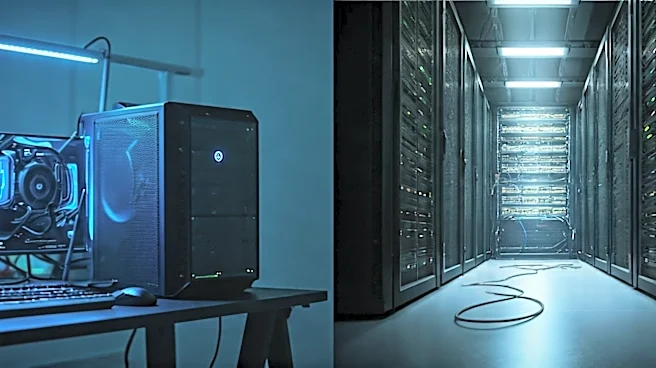

The Lab: A World of Perfect Conditions
In the development phase, diagnosing performance is, if not easy, at least straightforward. Developers work in a controlled environment, a digital laboratory. The servers are pristine, the network connections
are stable and lightning-fast, and the hardware is known and consistent. When engineers test for latency, they often use bots or scripts—'simulated players'—that perform predictable actions. This setup is essential for establishing a baseline. It allows teams to answer questions like: “Under ideal conditions, how fast is our game?” They can run a test, analyze the clean, manageable data, tweak a line of code, and run it again to see the impact immediately. In this world, problems are often reproducible. If a bug causes a lag spike when 20 players are on screen, you can reliably spawn 20 players and watch it happen. This process is methodical and scientific, but it’s built on one massive, misleading assumption: that the real world is anything like the lab.
Enter Production: The Chaos of Reality
The moment a game goes live—moves to “production”—that pristine laboratory is shattered. The game isn’t running on a handful of clean servers anymore; it’s distributed across a global network, serving tens of thousands or even millions of players simultaneously. And those players are the biggest variable of all. Instead of a clean, high-speed fiber optic connection, you now have a chaotic mix of every internet connection imaginable. There’s the player on a university’s blazing-fast ethernet, another on spotty rural satellite, and a third on a smartphone tethered to a shaky 4G signal in a moving car. Diagnosing a latency report from “Player_420” is no longer about your code; it’s about their ancient Wi-Fi router, their ISP’s overloaded network, or the transatlantic cable their data is bouncing through. The problem has shifted from “is our game fast?” to “why is our game slow for *this person*, right now?”
The Human Element: Players Don't Follow Scripts
Simulated players are useful, but they lack the beautiful, chaotic creativity of real humans. Developers might test a server's ability to handle 100 players spread across a map. But they can’t always predict that 500 players will decide, all at once, to congregate in a single, un-optimized broom closet because of a viral meme, causing the server for that zone to melt down. This is the emergent behavior that only appears in production. Players discover exploits, push game mechanics to their absolute limits, and coordinate in ways that automated tests simply can't. A sudden lag spike might not be a network issue at all, but the result of a popular streamer leading their entire audience to perform a computationally expensive action at the same time. This turns diagnostics from a technical problem into a socio-technical one.
The Data Problem: Finding Needles in a Haystack
In the lab, developers can capture every bit of data. In production, that’s impossible and impractical. With millions of players, the firehose of telemetry data—performance metrics from every single player’s computer and every server—is overwhelming. The challenge isn't collecting data; it's filtering the signal from the noise. Is a reported lag spike a genuine server-side problem affecting thousands, or is it an isolated issue for one player with a bad connection? Is a performance dip related to a new game patch, or did a major internet backbone provider just have an outage in North America? To answer this, engineers rely on sophisticated observability platforms that aggregate and correlate data from millions of endpoints. They hunt for patterns, trying to connect a spike in server CPU usage in a Virginia data center with a cluster of complaints from players in Ohio. It's less like being a mechanic fixing a single engine and more like being an air traffic controller watching thousands of planes at once, trying to spot the one that's flying erratically.