
The artificial intelligence revolution is running on all cylinders, with data centers popping up like mushrooms after a rainstorm. But behind the curtain of multi-billion-dollar AI accelerators, a critical
component is quietly throttling the pace of expansion.
What Is HBM and Why Does AI Crave It?
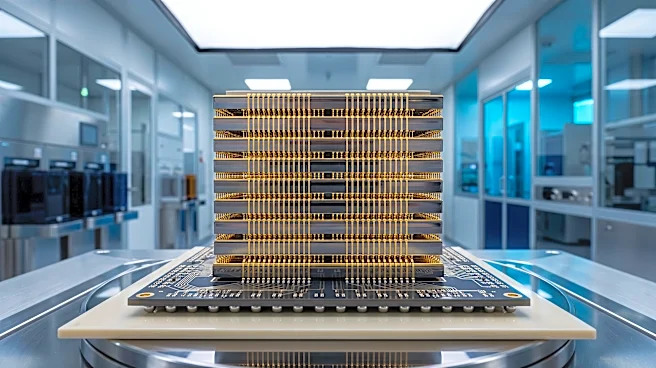
At the heart of the issue is High-Bandwidth Memory, or HBM. Think of it as the difference between a single-lane country road and a 16-lane superhighway. Traditional computer memory (DRAM) can only move so much data at once. For everyday tasks like browsing the web or working on a spreadsheet, that's perfectly fine. But the massive large language models (LLMs) that power today's AI are incredibly data-hungry. To keep the ultra-powerful graphics processing units (GPUs) from companies like Nvidia from sitting idle, they need a constant, massive firehose of data. HBM provides exactly that. By stacking memory chips vertically and connecting them with thousands of pathways, HBM creates an incredibly wide channel for data to flow directly to the processor. This design is essential for the complex calculations involved in training and running AI models, making HBM an indispensable part of every serious AI chip.
A Three-Horse Race for a Golden Goose
The problem is, you can't just order HBM from a catalog. Its manufacturing process is far more complex and delicate than standard memory, and the entire global supply is controlled by just three companies: SK Hynix, Samsung, and Micron. These firms are in an enviable position. The demand for their product is insatiable, and they have enormous pricing power. However, ramping up production isn't a matter of simply flipping a switch. Building new fabrication plants costs billions of dollars and takes years. As a result, the supply of HBM for 2026 is already almost entirely sold out, with analysts expecting the shortage to persist through 2027 and possibly longer.
Nvidia's Dilemma and the Ripple Effect
This creates a fascinating dilemma for AI chip leaders like Nvidia. While the company is posting record revenues, its growth is fundamentally constrained by what its memory suppliers can produce. Nvidia has responded by making staggering longterm supply commitments, with one analyst report suggesting it has already locked up over a third of the world's projected HBM supply for 2027. This aggressive move secures its own pipeline but squeezes everyone else. The economic incentives are so strong that memory makers are actively reallocating factory capacity away from the conventional DRAM used in laptops, smartphones, and cars to focus on the much more profitable HBM. This strategic shift is causing a ripple effect, leading to price hikes and potential shortages for consumer electronics and enterprise hardware that have nothing to do with AI.
The Search for a Workaround
The industry isn't standing still. The HBM constraint has become a primary driver of innovation. Nvidia itself is reportedly exploring chip designs that use less HBM per GPU, a tradeoff that could allow it to ship more total units even if each one is slightly less powerful. Meanwhile, competitors like Qualcomm are developing alternative architectures, such as their High Bandwidth Compute (HBC) technology, which aims to reduce the reliance on HBM by moving computation closer to the memory itself. These efforts highlight a new reality in the tech world: for the foreseeable future, the pace of the AI revolution may not be dictated by the cleverest algorithm or the fastest processor, but by the sheer availability of this one specialized memory component.