









The Building Blocks: A Shared Foundation
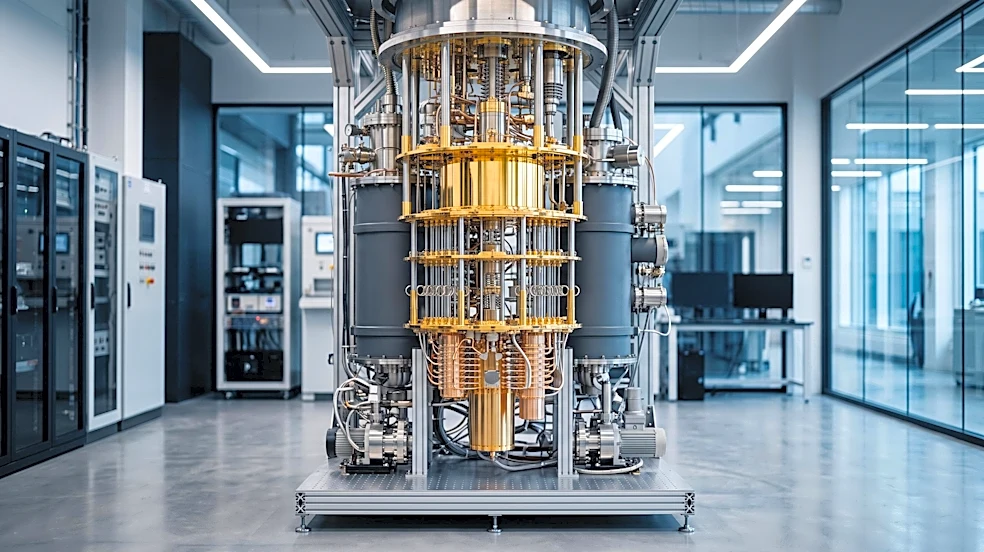
At the heart of both IBM's and Google's machines are superconducting 'transmon' qubits. Think of these as the fundamental units of quantum information, akin to the bits in your laptop, but far more powerful and fragile. They are tiny circuits, chilled
to temperatures colder than deep space in massive refrigerators, and manipulated with microwave pulses. Both companies use this same underlying technology because it's relatively mature and leverages existing semiconductor manufacturing techniques. But this is where the similarities end. The two giants have different priorities in how they design, connect, and control these qubits, leading to a crucial divergence in strategy.
The Scaling Philosophy: Go Big vs. Go Perfect
The most significant trade-off is a classic 'quantity versus quality' debate. IBM has pursued an aggressive public roadmap focused on scale, consistently building processors with more and more qubits. Their strategy is to get increasingly powerful hardware into the hands of a broad user base via the cloud, creating a full-stack ecosystem for clients to experiment with. This approach aims to find 'quantum utility'—where even noisy, non-perfect systems can start providing value on certain problems sooner rather than later. In contrast, Google has historically focused more on research-driven milestones aimed at quality. Their goal is to prove that quantum error correction—the holy grail for stable quantum computing—is viable. This means they might work with fewer qubits but engineer them to an incredibly high standard to demonstrate that the core principles of a fault-tolerant machine are sound, as they did with their Sycamore and more recent Willow processors.
Making Connections: The Qubit Social Network
A qubit's power comes from its ability to interact with others, a property known as entanglement. How you wire them together, or their 'topology', has massive implications. Google has often favored a grid-like architecture, which is ideal for a promising error-correction scheme known as the 'surface code'. This design methodically lays out qubits in a way that allows them to check on their neighbors and correct for errors as a group. IBM, on the other hand, developed a 'heavy-hex' lattice. This topology has lower connectivity—meaning each qubit has fewer direct neighbors. While this can make some algorithms trickier to run, IBM argues it helps reduce interference, or 'crosstalk', between qubits, which is a major source of computational noise in tightly packed chips. It's a trade-off between the ideal layout for a specific error-correction theory versus a pragmatic design to minimize noise in today's machines.
Fighting the Noise: The Error Correction Bet
Qubits are incredibly fragile; even a stray particle of light can ruin a calculation. Both companies know that long-term, useful quantum computers must be 'fault-tolerant'. This means using many physical qubits to create a single, ultra-stable 'logical qubit'. Google's entire strategy is heavily geared toward this, with major experiments demonstrating that as they add more physical qubits to their surface code, the error rate of the resulting logical qubit actually goes down. IBM is also laser-focused on fault tolerance but is architecting its systems around different error-correcting codes, such as qLDPC codes, which they believe may be more efficient and require fewer physical qubits in the long run. IBM's public roadmap explicitly charts a course toward fault-tolerant systems like its planned 'Starling' and 'Blue Jay' machines, aiming to combine hundreds and eventually thousands of qubits to run billions of operations.