







Surprise 1: The Power Is Real, and It's Spectacular
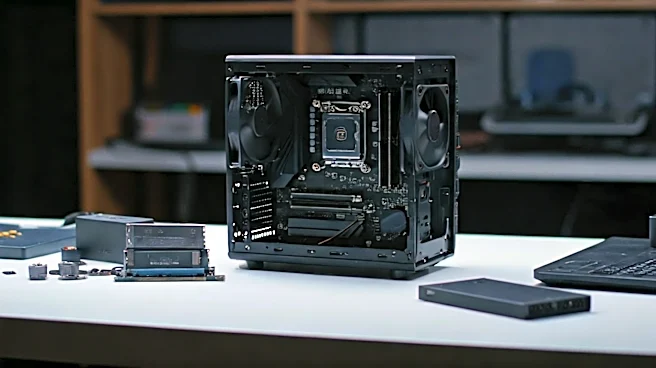
Let's start with the best surprise. Many newcomers assume a smaller PC must be a weaker PC. A decade ago, that was largely true. Today, it’s the opposite. Thanks to incredible advancements in component design, you can fit a top-tier processor and a high-end
graphics card into a case the size of a shoebox. Modern Mini-ITX motherboards and compact GPUs mean you no longer have to sacrifice performance for a smaller footprint. For many first-timers, seeing their tiny rig handle demanding games and creative workloads just as well as a monolithic tower is a jaw-dropping moment. It’s no longer a niche for home theater PCs; it’s a full-fledged enthusiast platform.
Surprise 2: Your New Hobby Is Heat Management
Here's the first challenge: all that power generates a serious amount of heat in a very small space. Unlike spacious towers with tons of airflow, every component in a mini PC is fighting for fresh air. This is the biggest shock for many builders. Thermal management isn't an afterthought; it's the entire game. You'll spend more time planning airflow, selecting low-profile CPU coolers, and checking temperature clearances than you ever thought possible. Realizing that a cooler is 2mm too tall for your case or that your cables are blocking the only air intake is a rite of passage for SFF builders.
Surprise 3: The 'Small Form Factor Tax' Is Real
The next surprise hits the wallet. Intuitively, smaller should mean cheaper, but in the world of PC parts, it's often the reverse. Specialized components required for SFF builds—like Mini-ITX motherboards, SFX power supplies, and low-profile coolers—are manufactured in lower volumes and require more complex engineering. This results in a phenomenon builders call the "SFF tax," where you pay a premium for compactness. While a basic build can be affordable, creating a high-performance mini PC often costs more than an equivalent standard-sized machine.
Surprise 4: It’s a 3D Puzzle, Not Just an Assembly
Building a standard PC is like following a recipe. Building a mini PC is like trying to build a ship in a bottle. The process is significantly more difficult and requires a level of planning that can surprise even experienced builders. You can't just install components in any order. Often, the motherboard has to go in last, or you have to plug in tiny cables before a larger component blocks access forever. Cable management is not about making things look pretty; it's a desperate fight for every cubic centimeter of space to avoid obstructing airflow or preventing a side panel from closing.
Surprise 5: You'll Care Deeply About Noise Levels
In a large tower PC, you can use big, slow-spinning fans that are virtually silent. In a cramped SFF case, you often rely on smaller fans that need to spin faster to move the same amount of air. This can lead to a surprisingly noisy machine if you're not careful. This forces first-timers to learn about fan curves, undervolting components to reduce heat output, and strategically choosing cases with good ventilation. The sudden roar of a tiny fan spinning up to cool a struggling component is a surprise that quickly sends builders down the rabbit hole of quiet computing.
Surprise 6: You'll Actually Take It With You
After all the planning, building, and troubleshooting, the final surprise is perhaps the most rewarding: genuine portability. While most desktop PCs are destined to live under a desk for their entire lives, a mini PC can be easily unplugged and taken to a friend's house for a LAN party, moved to the living room TV, or packed into a backpack for travel. This mobility fundamentally changes how you think about and use your computer, turning it from a static piece of furniture into a powerful, portable companion.