







The Garage and the Light Bulb Trick
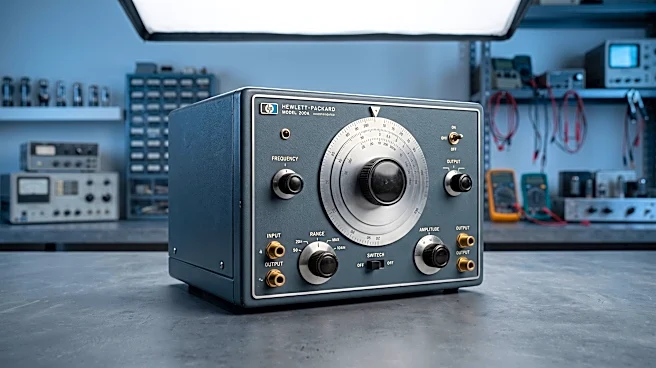
In 1938, two Stanford graduates, Bill Hewlett and Dave Packard, started a company in a one-car garage with just $538. Their first product was the HP Model 200A, an audio oscillator designed to test sound equipment. It was born from Hewlett's master's
thesis and featured a clever innovation: it used a small incandescent light bulb to stabilize the circuit. This simple, inexpensive trick solved a distortion problem that had stumped competitors, allowing them to build a more stable and accurate device for a fraction of the cost. While similar devices sold for hundreds of dollars, HP priced theirs at just $54.40, a number Hewlett reportedly chose as a nod to the historical slogan "Fifty-four Forty or Fight!". To give the impression that they were an established company, they didn't call it the Model 1; they started at 200.
A Fantasia of a First Client
The company's big break and the cornerstone of its mythology came from Hollywood. A sound engineer from Walt Disney Studios saw the oscillator and was impressed. Disney was working on the movie Fantasia, which featured a pioneering stereophonic sound system called "Fantasound." They needed reliable, precise audio oscillators to test and calibrate the revolutionary sound setup in theaters. The standard 200A wasn't quite right, so Hewlett modified it to meet Disney's specific frequency range needs, creating the Model 200B. Disney ordered eight of them. The total sale was just over $570, more than the initial capital Hewlett and Packard had invested to start the company. This order was immense validation; it proved their product had real-world value and that their tiny garage operation could actually survive.
The Sound of Commercial Silence
Here’s the twist in the triumphant tale: beyond the legendary Disney sale, the HP200A was not a commercial hit. While it was a technical marvel that drew praise within engineering circles, it was a niche product with a very limited market. The Disney order was a huge morale boost and a critical injection of cash, but it wasn't followed by a flood of similar orders. The company recorded modest profits in its first year, but it was hardly a runaway success. The initial growth came from variations on the oscillator and, more significantly, from contracts related to World War II, which pushed the young company into manufacturing a wider range of electronic instruments. The "failure" of the 200A wasn't that it was a bad product—it was brilliant. Its failure was purely commercial: it didn't have a large enough addressable market to build a major company on.
A Blueprint Born From Failure
The true legacy of the HP200A wasn't its sales figures. Its real value was the lesson it taught Hewlett and Packard. They learned that a brilliant invention isn't enough; a successful business needs a market, a sales strategy, and a plan for growth beyond a single, high-profile customer. They realized that their greatest product wouldn't be a single gadget, but the company itself. This realization led to the development of "The HP Way," a management philosophy that prioritized technical contribution, customer focus, and employee trust. After the initial experience with the oscillator, HP diversified its product line, developing a range of test and measurement equipment that established its reputation for quality and innovation. The oscillator's design lineage was so sound that updated versions remained in production for decades, but the company's survival and growth depended on moving far beyond it.