







The Metal Box Problem
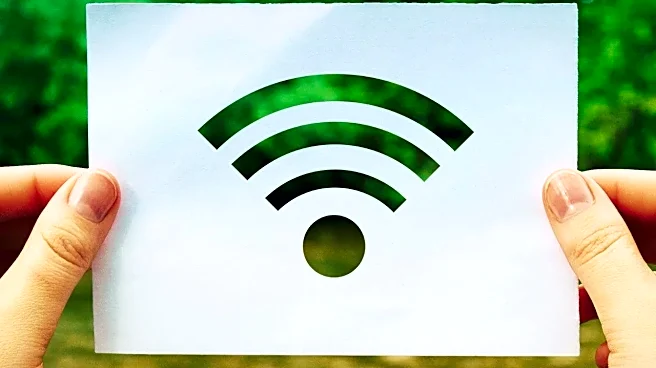
The biggest culprit behind your tiny home's connectivity woes is often its construction. Many tiny homes, like modern sheds and RVs, use metal siding and roofing for durability and weather resistance. While great for longevity, metal is the number one
enemy of Wi-Fi. It essentially turns your home into a Faraday cage, an enclosure made of conductive material that blocks electromagnetic fields, including the radio waves your router uses. The Wi-Fi signals from your router literally bounce off or get absorbed by the metal, preventing them from ever reaching your devices reliably. It’s not about signal strength in the traditional sense; it's about a physical barrier that even the most powerful router can't easily penetrate. This is why a device might show full bars one moment and have no connection the next.
An Interior Full of Obstacles
Even if your tiny home is built primarily from wood, the interior presents a unique set of challenges. By design, tiny living is about maximizing function in a minimal space. This means walls are packed with plumbing, electrical wiring, and space-saving appliances. Your kitchen area, with its stainless steel fridge, microwave, and oven, creates a concentrated zone of signal-reflecting metal. Bathrooms, with their mirrors, pipes, and tile, also wreak havoc on Wi-Fi waves. In a larger home, these obstacles are spread out. In a tiny home, they are all condensed into a small area, creating a chaotic environment where signals are constantly blocked, reflected, and weakened before they can travel just a few feet.
Why Standard Fixes Don't Work
The go-to solution for bad Wi-Fi in a regular house is often a range extender or a more powerful router. However, these tools are designed to solve problems of distance, not physical barriers. A Wi-Fi extender works by picking up a weak signal and rebroadcasting it. But if the metal walls are preventing a signal from getting out in the first place, the extender has nothing to amplify. Placing a more powerful router inside the home is like shouting louder in a soundproof room—the energy is trapped. If a router is placed inside a shielded space, it can even make things worse by causing the signals to bounce around and amplify internally, creating more interference.
Smarter Solutions for Small Spaces
Solving the tiny home Wi-Fi puzzle requires a different approach. Instead of trying to blast a signal through the walls, you need to work around them. One of the most effective solutions is a point-to-point wireless bridge. This involves placing one antenna outside the tiny home where it can get a clear signal from the main internet source, and another unit inside that's connected via a cable. This bypasses the signal-blocking exterior entirely. Another popular and effective strategy is a mesh network. By placing small nodes throughout the space, you create a web of coverage that can navigate around interior obstacles. For those parked near a host house, running a simple, weather-rated ethernet cable from the main router to your own wireless access point inside the tiny home is often the most reliable and straightforward method.