





The Doomsday Projection
The year is 2013, and Google is facing an existential threat that has nothing to do with competition. The company’s engineers are embracing a powerful new form of AI called deep learning to improve everything from search results to voice recognition.
There’s just one problem: the cost. Projections showed that if users started using Google voice search for just three minutes a day, the computational demand from these new AI models would force the company to literally double the number of its already massive data centers. This wasn't a matter of lower profits; it was a question of economic impossibility. Building that many data centers would be ruinously expensive and take years. Relying on standard CPUs was a dead end.
Why Not Just Use GPUs?
The obvious next step was to look at Graphics Processing Units (GPUs). Already popular in scientific computing and the nascent AI research scene, GPUs were great at parallel processing. But they weren't a perfect fit for Google's specific problem. GPUs are like a Swiss Army knife: powerful and flexible, but loaded with tools you don't always need. They were designed for rendering complex graphics, which requires high-precision floating-point calculations. For running AI inference—the task of using a pre-trained model to make a prediction—that level of precision was overkill. This made GPUs less efficient in terms of performance-per-watt for the specific, high-volume task Google needed to solve. They were a good solution, but not a hyper-efficient one at the planetary scale Google operates.
A Radical, Narrow Focus
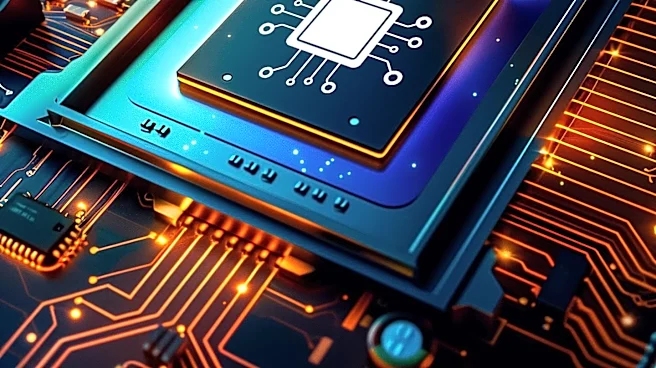
Led by veteran chip architect Norm Jouppi, a team at Google decided on a radical path: build their own chip from scratch. This Application-Specific Integrated Circuit (ASIC) would be called the Tensor Processing Unit. Its design philosophy was one of ruthless focus. Instead of being good at many things, the first TPU was designed to do one thing perfectly: run AI inference using Google’s TensorFlow framework. It made a crucial trade-off, sacrificing the high precision of GPUs for lower-precision 8-bit integer math. While this would be a disaster for scientific simulations, it was perfectly fine for many neural networks, and it allowed for a massive boost in efficiency. The TPU was a scalpel, not a Swiss Army knife. In an astonishing feat of engineering, the team went from design to deployment in just 15 months.
The Secret Sauce: Systolic Arrays
The heart of the TPU's efficiency is an architecture called a systolic array. Imagine a bucket brigade at a fire. A CPU is like one person running back and forth with a bucket. A GPU is like thousands of people running back and forth at once—more water gets moved, but it’s chaotic and energy-intensive. A systolic array is different. It’s like a line of people standing still, passing the buckets from one to the next. In the TPU, data flows through a grid of thousands of simple calculators in a rhythmic pulse, like a heartbeat (the name “systolic” comes from the same Greek root). This design drastically reduces the most energy-intensive part of computing: fetching data from memory. By keeping data moving through the processors, the TPU performs a massive number of calculations for every watt of energy consumed. The first TPU had a 256x256 array, meaning it contained 65,536 calculators working in perfect synchrony.
From Secret Weapon to Industry Catalyst
For over a year, TPUs operated in secret inside Google's data centers, powering products like Search and Photos and quietly averting the data center crisis. When Google finally revealed its creation in 2016, the results were staggering. For AI inference, the TPU was 15 to 30 times faster than contemporary CPUs and GPUs, and 30 to 80 times more power-efficient. What began as an internal solution quickly became a major strategic asset. Google later developed versions capable of training AI models and now offers them to customers via Google Cloud, creating a key differentiator in its battle against other cloud giants. More importantly, the TPU’s success kicked off a gold rush, inspiring a new generation of custom AI chips from startups and tech giants alike, all chasing the same efficiency gains that Google proved were possible.