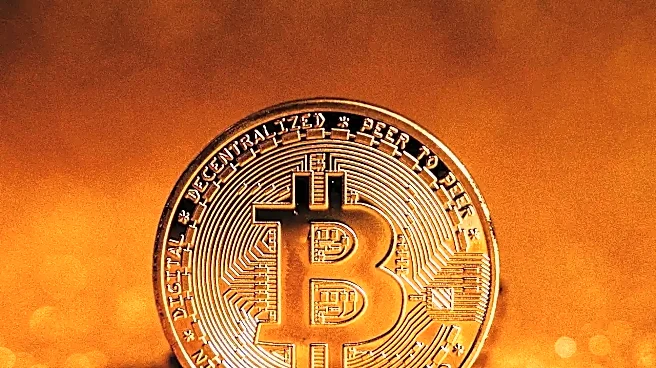








Myth: Bitcoin Was Created to Be 'Digital Gold'
The most powerful narrative driving Bitcoin investment is that it’s “digital gold”—a scarce asset for storing value and hedging against inflation. This idea is so pervasive that even top financial executives who were once critics now endorse it. But the
original blueprint says something completely different. The whitepaper’s title is “Bitcoin: A Peer-to-Peer Electronic Cash System.” It doesn't mention “digital gold,” “store of value,” or “inflation hedge” even once. Satoshi Nakamoto’s stated goal was to create a system for online payments that worked like physical cash, allowing two parties to transact directly without needing a bank or financial institution as a trusted third party. The entire paper is a technical solution to a specific problem: preventing “double-spending” in a decentralized network. The narrative of Bitcoin as a long-term investment to be held (or “HODL’d”) came much later, as its price volatility and scaling limitations made it less practical for small, everyday purchases.
Myth: The Fixed Supply Was for Price Scarcity
Investors rightly point to Bitcoin’s hard cap of 21 million coins as a key feature. It's often cited as the primary reason for its potential to increase in value, mirroring the scarcity of precious metals. While the scarcity is real and hard-coded, its purpose in the original design was more technical than economic. In the whitepaper, the slow, predictable release of new coins serves as the primary incentive mechanism for “miners”—the network participants who validate transactions. By expending computing power to secure the network, they are rewarded with new Bitcoin. Satoshi drew an analogy to gold miners expending resources to add gold to circulation. The goal was to create a self-sustaining, decentralized system for transaction processing, not to engineer a speculative asset defined by its scarcity. The fixed supply prevents arbitrary inflation within the system, which is crucial for a form of cash, but its role as a driver for speculative investment is a by-product, not the core mission.
Myth: It's an Anonymous and Untraceable System
Another common belief, especially among those new to crypto, is that Bitcoin offers total anonymity, like a digital briefcase full of unmarked bills. This misunderstanding stems from the fact that you don’t need to link your real-world identity to a Bitcoin address. However, the whitepaper clarifies that the system is “pseudonymous,” not anonymous. Every single transaction is recorded on the public blockchain, a permanent, immutable ledger that anyone can view. Think of it less like a secret diary and more like a public square where everyone wears a mask. While your name isn't attached to a transaction, the address is. If that address is ever linked to your identity—through a crypto exchange that requires ID, for example—your entire transaction history can be traced. This level of public transparency is fundamental to the system’s security, but it’s a far cry from the untraceable digital cash some investors imagine.
Myth: The Whitepaper Is an Investment Manifesto
Given the fortunes made and lost, many assume the whitepaper must be a kind of investment prospectus, outlining the path to riches. The reality is quite the opposite. The document is a dry, academic, and highly technical paper focused on solving a computer science problem. It describes things like timestamp servers, proof-of-work, and simplified payment verification. There is no mention of market capitalization, price speculation, or future value. The paper was released on a cryptography mailing list in the wake of the 2008 financial crisis, a time of deep distrust in financial institutions. Its revolutionary idea was the creation of a trustless system for payments, where value could be exchanged without relying on banks that had proven fallible. The speculative frenzy that followed was a market phenomenon built on top of the technology, but it was not the technology's stated purpose.