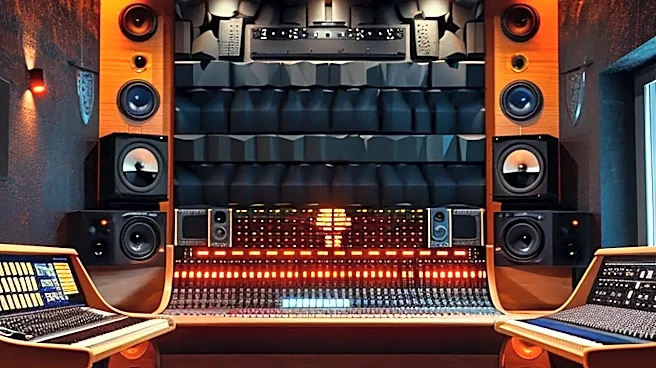









The Deception of 'Good' Sound
The fundamental mistake many aspiring producers make is using consumer-grade speakers for production. Whether it’s a pricey home stereo system or a nice pair of headphones, these products are designed for one thing: enjoyment. They are engineered to make music
sound 'better' by boosting certain frequencies, often scooping the mids and hyping the bass and treble. This creates a pleasant, flattering listening experience but provides a dishonest representation of your actual audio. Think of it like a funhouse mirror; it’s an entertaining distortion, but you wouldn’t use it to check your haircut. Studio monitors, by contrast, are built for the opposite purpose: brutal honesty. They are precision tools designed to reveal every flaw, every misplaced frequency, and every subtle imperfection in your mix.
In Pursuit of Truth: Flat Frequency Response
The single most important characteristic of a professional studio monitor is its 'flat frequency response'. This means the speaker aims to reproduce all audible frequencies, from the lowest sub-bass to the highest sizzle of a cymbal, at the exact same level. It doesn't add warmth to the bass or sparkle to the highs; it simply presents the audio as it truly is. Working on monitors with a flat response is like a graphic designer working on a color-calibrated screen. If the screen artificially boosts the color red, the designer might compensate by reducing red in their design, only to find the final print looks pale and lifeless. Similarly, if your speakers boost bass, you’ll likely reduce the bass in your mix to compensate. The result? A track that sounds thin and weak on every other system.
Will It Play in the Car? The Translation Test
This leads to the ultimate goal for any mix engineer: translation. A mix that 'translates' well sounds consistent and balanced across a wide variety of playback systems—from high-end car stereos and club PAs to cheap earbuds and laptop speakers. This is where professional monitors prove their worth. By providing an uncolored, accurate reference point, they allow you to make mixing decisions that will hold up in the real world. You can confidently adjust equalization and compression knowing that you're fixing genuine issues in the mix, not just problems created by your inaccurate speakers. The goal isn't to make the mix sound perfect on your monitors; it's to make a mix on your monitors that will sound great everywhere else.
More Than Just Speakers: Your Room Is an Instrument
It’s important to note that even the best monitors are only half the battle. The room you mix in has a dramatic impact on what you hear. Sound waves bounce off hard surfaces like walls, ceilings, and floors, creating echoes, frequency buildups, and nulls that can completely distort the sound before it reaches your ears. This is why professionals invest in acoustic treatment and why most studio monitors are 'near-field' monitors. Near-field monitors are designed to be placed close to the listener, minimizing the influence of the room's acoustics and allowing you to hear more of the direct sound from the speaker itself. While a perfectly treated room is the ideal, starting with accurate near-field monitors is the most critical first step toward a reliable listening environment.