





The Battle Everyone Knows
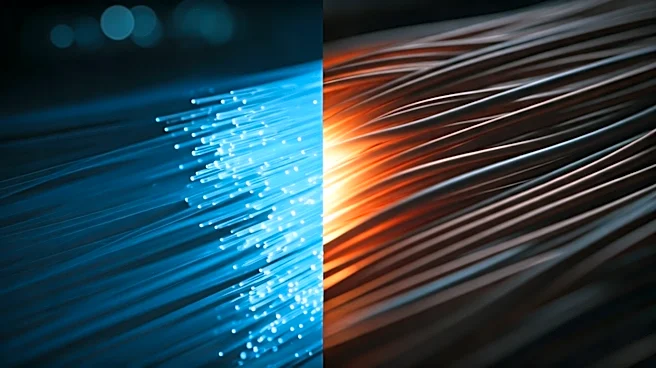
Ask any network enthusiast or budding engineer about the difference between fiber optic and copper cabling, and you'll get a familiar answer. It’s a story of speed, bandwidth, and distance. Fiber optic cables, which transmit data as pulses of light through
glass strands, offer mind-boggling speeds over immense distances with minimal signal degradation. They are the undisputed champions of the data center and the backbone of the modern internet. Copper twisted-pair cables, like the Cat6 or Cat7 you might have plugged into your router, transmit data using electrical signals. They’re workhorses, but they have their limits. They are susceptible to signal loss over shorter distances (think a 100-meter limit for most Ethernet standards) and are vulnerable to electromagnetic interference (EMI) from nearby power lines or large motors. In a head-to-head race of pure data throughput, fiber optics wins, no contest. And that’s where most of the analysis stops.
The Detail Hiding in Plain Sight
Here’s the detail that often gets lost in the spec-sheet showdown: copper cables can carry electrical power. Fiber optic cables, being made of glass or plastic, cannot. This capability, known as Power over Ethernet (PoE), is a game-changer that fundamentally alters the decision-making process for network design. Using a single copper Ethernet cable, a device can receive both its data connection and the low-voltage electricity it needs to operate. This elegant solution eliminates the need for a separate power cord and a nearby electrical outlet for every connected device. It’s a seemingly small feature that has massive implications for cost, complexity, and deployment flexibility. While fiber is a pure data medium, copper is a hybrid workhorse, and overlooking this dual-purpose function is a classic mistake for those focused only on theoretical maximums.
Power, Practicality, and Project Costs
Why does PoE matter so much? Think about where network devices actually go. Security cameras mounted high on building exteriors, wireless access points on ceilings in warehouses, VoIP phones on desks throughout an office, or digital signage in a shopping mall. In many of these locations, a data port is available, but a power outlet isn't. With copper and PoE, installation is simple: you run one cable and you're done. With fiber, you have two problems to solve: data and power. This means running a separate electrical conduit, hiring an electrician, and adding significant cost and complexity to the installation. There are workarounds, like hybrid fiber-copper cables or local power injectors, but these add their own costs and points of failure. For any project involving dozens or hundreds of distributed devices, the cost savings and simplicity of using PoE with copper can easily outweigh the raw bandwidth advantages of fiber for the “last mile” connection to the device itself.
Beyond Power: Other Overlooked Trade-Offs
While power delivery is the biggest missed detail, other nuances often get glossed over. The very thing that makes copper vulnerable—its electrical conductivity—also makes it a security risk. It’s relatively easy to “tap” a copper cable non-invasively to eavesdrop on the signal. Tapping a fiber optic cable is significantly more difficult, requiring specialized equipment that physically interrupts the light path, an intrusion that is far easier to detect. Furthermore, fiber’s immunity to EMI isn't just a minor perk; it's a critical requirement in environments like hospitals with sensitive imaging equipment, factory floors with heavy machinery, or any building with “noisy” electrical systems. In these scenarios, using copper would risk data corruption and unreliable performance, making fiber the only viable choice, regardless of its inability to deliver power. The truly experienced engineer understands that context, not just a single metric, dictates the correct choice.