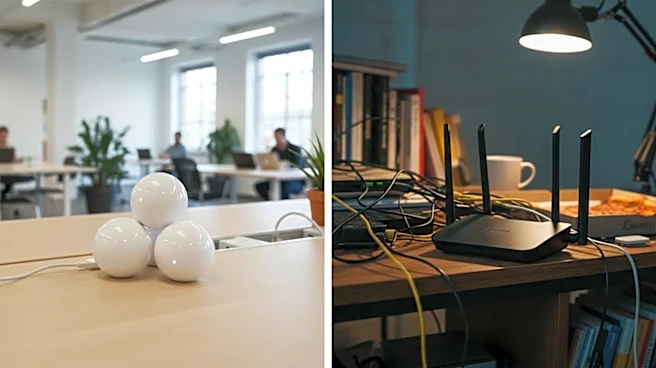










The Modern Promise of Mesh Wi-Fi
Mesh Wi-Fi systems are the darlings of the modern connected home and small office. Their promise is seductive: a series of stylish nodes you plug in around a space, which then talk to each other to create a seamless, powerful network. Setup is usually
done through a simple smartphone app, eliminating the need for complex configuration. For a small, open-plan office or a home, mesh is often a fantastic solution that kills dead zones with minimal fuss. The appeal is obvious—it feels futuristic, flexible, and easy. It’s this consumer-friendly experience that makes it a tempting first choice for a new coworking space. The idea of blanketing a large area in strong Wi-Fi without running cables feels like a win.
The Old Guard: Traditional Access Points
The traditional alternative isn't a single beefed-up router, but a system of dedicated Access Points (APs). Think of these as professional-grade Wi-Fi broadcasters, each wired directly back to a central network switch with an Ethernet cable. This setup is the standard for large enterprises, universities, and stadiums for a reason. Each AP gets a full-speed, dedicated data connection, so its performance isn't compromised by talking to other nodes wirelessly. Management is centralized, allowing a network administrator to control security, user access, and performance from a single dashboard. While installation is more invasive and costly upfront due to cabling requirements, the result is a robust, predictable, and highly scalable network designed for serious business.
The Coworking Complication: Density
This is where the script flips. A coworking space is not a large home or a typical small office. It's a high-density environment. A home might have a dozen devices connected at once; a coworking space can have hundreds, all demanding stable bandwidth for video calls, large file transfers, and constant cloud access. This is where consumer and even some business-grade mesh systems falter. Mesh nodes that communicate wirelessly are, by definition, using some of their available airtime to talk to each other instead of to user devices. As more users connect, the network becomes congested, and speeds can plummet. A system of wired APs, however, is built for this exact scenario. Each AP has its own dedicated lane back to the internet, allowing it to handle a heavy load of users without bottlenecking the entire system.
The Engineer's Dilemma: Control and Security
This is the pitfall that trips up smart people who are used to solving problems in other environments. A senior engineer might favor the elegant simplicity of a mesh network, underestimating the unique security and management needs of a coworking space. In a shared environment, you need granular control. For example, you need to isolate traffic between different member companies using VLANs (Virtual Local Area Networks) to ensure one company can't see another's data. You also need the ability to assign unique login credentials for each user, not just a shared password. Enterprise-grade AP systems are designed with these security features, such as WPA2-Enterprise authentication, built-in. Most consumer-focused mesh systems are not, as they're designed for a trusted family environment, not a commercial space with dozens of separate business entities under one roof.
Making the Right Call Isn't About 'Best'
So, is mesh always the wrong choice? Not necessarily, but its role is more specific. For a very small, open-concept coworking space with low member density, a high-end business mesh system might work. It can also be a good solution for filling a tricky dead spot where running a cable is impossible. However, for most growing coworking spaces—especially those with multiple private offices, conference rooms, and a high density of users—the debate is largely settled among network professionals. The superior performance, scalability, and security of a professionally installed system of wired access points almost always wins out. The mistake even senior engineers make is applying a solution that works brilliantly in one context (a home or small tech startup) to a completely different one (a high-density, multi-tenant commercial space) without fully appreciating the different demands.