



The Undisputed King of PC Gaming
For much of the late 1990s and 2000s, Nvidia was the brand for serious PC gamers. Founded in 1993, the company hit its stride with the release of the GeForce 256 in 1999, which it marketed as the world's first Graphics Processing Unit (GPU). This wasn't
just marketing jargon; the chip was a revelation, taking on the heavy lifting of rendering 3D graphics and freeing up a computer's main processor (CPU) to handle other tasks. For gamers, the result was a dramatic leap in visual fidelity and smoother frame rates in titles like 'Quake III Arena' and 'Unreal Tournament'. This cemented Nvidia's reputation. Its GeForce line of cards became the must-have component for anyone building a high-performance gaming rig, making the company a beloved, if relatively niche, hardware icon.
An Accidental Stroke of Genius
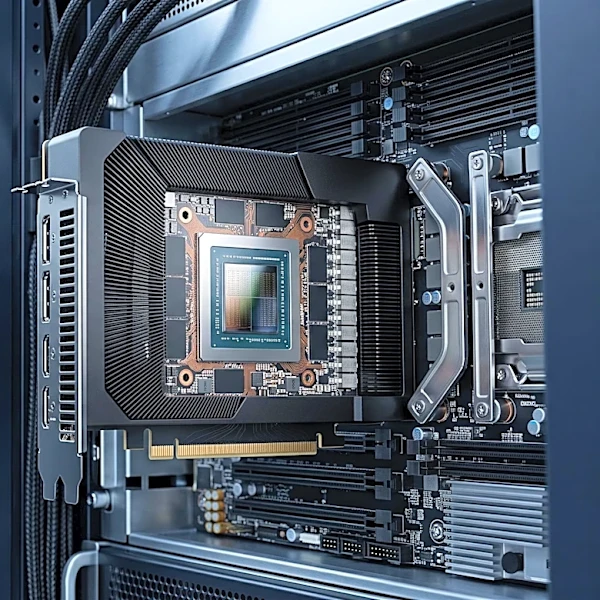
The magic of GPUs lies in their architecture. Unlike a CPU, which tackles complex tasks sequentially one by one, a GPU is a master of parallel processing. It uses thousands of simpler cores to perform a massive number of calculations simultaneously. This design was perfect for rendering graphics—calculating the color, light, and position of millions of pixels on a screen all at once. For years, this was seen as its primary, if not sole, purpose. But a key insight emerged: the type of math used for rendering 3D worlds was remarkably similar to the math required for other complex tasks, like scientific simulations and, most importantly, training neural networks. The hardware built for gaming had a hidden, far more powerful potential.
The Pivot: Unlocking the GPU with CUDA
Nvidia's true masterstroke was not just building powerful hardware, but creating the key to unlock it. In 2006, the company released CUDA (Compute Unified Device Architecture), a software platform that allowed developers to program its GPUs for general-purpose computing. Before CUDA, using a GPU for anything other than graphics was a highly specialized and difficult task. CUDA changed everything by providing a software bridge, letting programmers in fields like scientific research and finance harness the parallel processing power of Nvidia's chips for their own applications. This strategic investment in a software ecosystem, years before the AI boom, laid the foundation for Nvidia’s complete transformation.
Fueling the Artificial Intelligence Gold Rush
The pivotal moment came in 2012. A neural network called AlexNet, which was trained using two Nvidia gaming GPUs, shattered records in an influential image recognition competition. It proved that deep learning models, when fed vast amounts of data and trained on GPUs, could achieve breakthrough performance. Suddenly, the entire AI research community turned its attention to Nvidia. The parallel processing power of its GPUs was perfectly suited for the intense, repetitive calculations required to train massive AI models. What once took months on CPUs could now be done in weeks or days. Nvidia found itself in the perfect position, providing the essential 'picks and shovels' for the ensuing AI gold rush.
From Pixels to a Tech Superpower
Today, Nvidia's identity has fundamentally shifted. While its gaming division continues to thrive, it's now a small fraction of the company's business. The Data Center segment, which supplies the powerful GPUs and systems like the DGX that run AI models in the cloud and for major corporations, now accounts for the vast majority of its revenue. The company's valuation has soared into the trillions, making it one of the most valuable companies in the world. Its chips are no longer just for creating virtual worlds in video games; they are the engines powering everything from generative AI and drug discovery to autonomous vehicles and scientific supercomputing.