
The Goal Isn't a Better Human Driver
The single biggest misconception about autonomous vehicles is that they’re being designed to be a better version of a human driver. We imagine an AI with the cool confidence of a race car driver and the impeccable
situational awareness of a Secret Service agent. The reality is far more robotic, and that’s intentional. The primary design goal for companies like Waymo and Cruise isn't to create a system that drives with human-like intuition, but to create one that is provably, mathematically, and boringly safe. Instead of trying to replicate the nuanced, often rule-bending improvisation of a seasoned human driver, engineers are building something fundamentally different: a road user that is, above all, predictable. Its every action is logged, its every decision based on a rigid hierarchy of rules. It doesn't 'feel' its way through traffic; it calculates a path of least risk.
Designed for the Lawyer, Not Just the Road
Every time an autonomous vehicle makes a decision—to change lanes, to brake, to navigate an intersection—it’s not just executing a driving maneuver; it's creating a legal record. The 'real reason' for much of their design is liability. In the event of an accident, every line of code and every sensor input will be scrutinized. Could the car have stopped sooner? Was its lane change executed according to protocol? As a result, autonomous systems are designed for maximum defensibility. This is why they often seem so timid. A human driver might nudge their way into a busy roundabout, making eye contact and using social cues. An autonomous car, lacking that social ability and programmed to never be at fault, will often wait indefinitely for a perfectly clear, textbook-safe opening. Its hesitation isn't a flaw in its driving ability; it's a feature of its risk-averse legal posture. It's programmed to lose the argument on the road to win the argument in court.
The Great Technological Divide
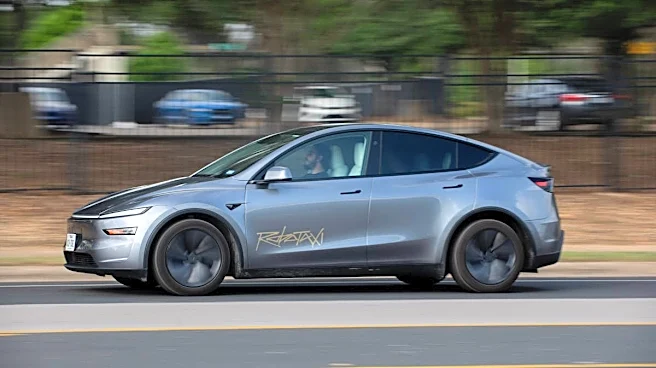
The different 'personalities' you see in autonomous vehicles can often be traced back to a fundamental split in their core technology. On one side, you have the Waymo approach, which relies heavily on high-resolution LIDAR (Light Detection and Ranging). Think of it as a spinning laser that builds a hyper-accurate, 3D map of the world in real time, supplemented by cameras and radar. This system excels at object detection and measurement, creating a world of pure geometry. It drives like a system navigating a precise digital model. On the other side is Tesla's vision-only approach, which seeks to solve autonomy using only cameras and neural networks, arguing that's how humans do it. This creates a system that has to interpret the world, learning to identify objects and predict their behavior from 2D images. This philosophical difference is huge: one is about mapping the world perfectly, the other is about understanding it visually. The resulting driving styles are a direct consequence of how they 'see'.
The Cautious Robot Problem
All of this leads to what we experience on the roads: the cautious, sometimes frustrating, robot. An autonomous vehicle might slam on the brakes for a plastic bag blowing across the street because its sensors classify it as an unknown, potentially hazardous object. It might refuse to make an unprotected left turn that a human would confidently complete because the risk calculation, however small, doesn't compute to zero. This ultra-conservative behavior is a direct result of prioritizing the avoidance of blame over fluid, efficient driving. While humans operate on a complex system of norms, assumptions, and risk acceptance, the autonomous system operates on a much simpler, more brutal logic: never be the proximate cause of a collision. Until these systems can perfectly predict the chaotic behavior of every human driver, pedestrian, and cyclist around them, their only logical move is to default to extreme caution.