



The High Priesthood of Early Code
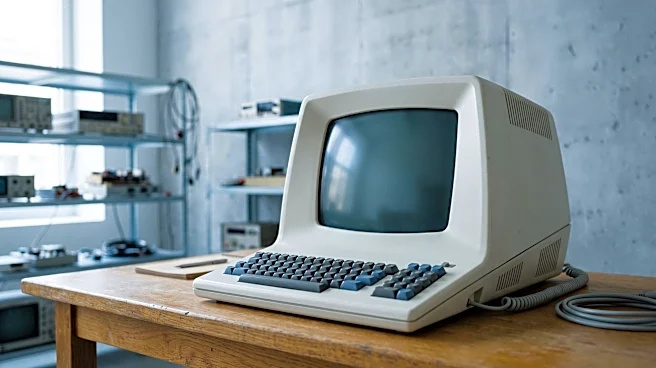
In the early 1950s, computers were mysterious, room-sized monoliths. Programming them was a job reserved for a select few, a kind of digital priesthood of mathematicians and engineers. They spoke to these machines in the only language they were thought
to understand: complex strings of numbers and arcane symbols. It was a tedious, error-prone process that made computers powerful but fundamentally inaccessible. The prevailing wisdom was clear: if you wanted to work with a computer, you had to learn its baffling language. The burden was on the human to adapt to the machine.
A Mathematician Goes to War
Grace Hopper was an unlikely revolutionary. A professor with a Ph.D. in mathematics from Yale, she joined the U.S. Navy Reserve in 1943 during World War II. Assigned to the computation project at Harvard, she became one of the first programmers of the Mark I computer. Hopper wasn't an engineer steeped in the hardware; she was a mathematician who saw the logic—and the inefficiency—of how humans were interacting with these powerful new tools. She believed the tedious work of manually translating ideas into machine code was a bottleneck. It was here, in a world dominated by men and rigid thinking, that she began to form a contrarian idea.
The Bet on Plain English
Hopper's hidden bet was simple, yet radical: What if computers could learn our language, instead of the other way around? She proposed that programming could be done using plain English words. The idea was met with immediate and widespread skepticism. Colleagues and superiors told her it was impossible; computers, they insisted, could only perform arithmetic and didn't understand English. But Hopper persisted, famously arguing that computers didn't understand math either—they only manipulated symbols. Her vision was to create a program, which she called a "compiler," that would act as a translator, automatically converting English-like commands into the machine code the computer required. For three years, her idea was largely rejected, but she built a proof anyway.
From Compiler to COBOL
In 1952, Hopper and her team completed the A-0, the first compiler. It was a groundbreaking achievement that proved her theory correct. This invention laid the foundation for machine-independent programming languages. Hopper's work led to FLOW-MATIC, the first programming language to use English-like commands. This, in turn, became the direct inspiration and basis for COBOL (Common Business-Oriented Language), which was developed by a committee on which Hopper was a key technical consultant. COBOL was designed to be readable by non-specialists, with commands like "ADD PRICE TO TOTAL." While some academics dismissed it as inelegant, businesses and governments embraced it. COBOL became the most ubiquitous business language in the world, running everything from banking systems to government agencies.
A Legacy of Accessibility
The true payoff of Grace Hopper's bet is the world we live in today. Her insistence on human-centric design democratized computing. By refusing to accept that technology had to be difficult, she cracked it open for a much broader audience, paving the way for the software, apps, and user-friendly interfaces we now take for granted. The idea that anyone, not just an expert, should be able to tell a computer what to do was once a radical notion. Hopper's legacy isn't just a programming language or an invention; it's the fundamental philosophy that technology should serve people. Her victory wasn't just technical; it was a philosophical shift that continues to shape our digital world.