




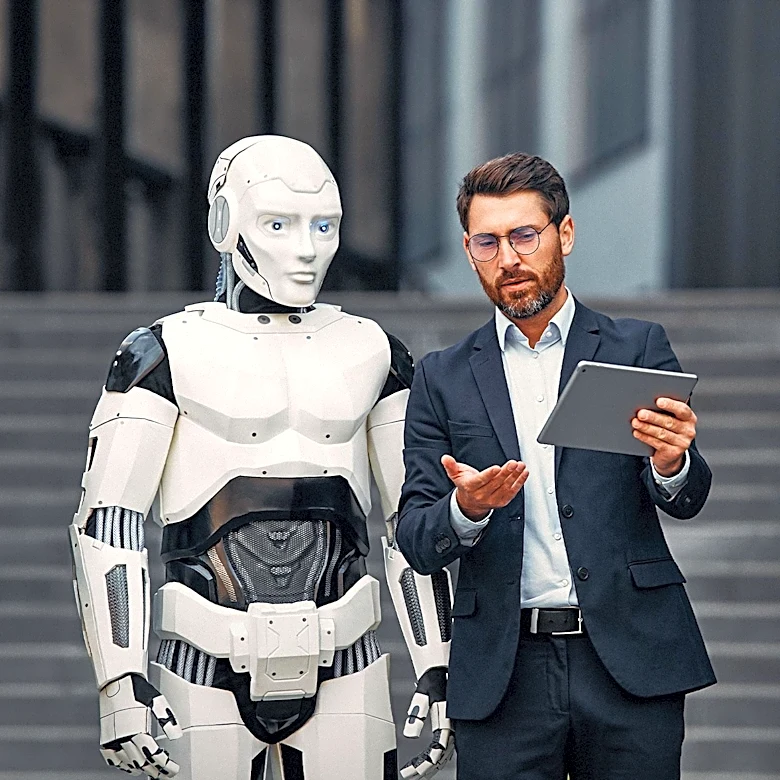



The Copilot: An Expert on Your Shoulder
The first model is the one most knowledge workers are familiar with today. The 'Copilot' is an advanced assistant embedded directly into existing workflows. Think of a writing aide in your word processor, a code-generator in a developer's toolkit, or a data
analyst inside your spreadsheet software. Its primary function is to assist a human who remains firmly in control. The copilot responds to prompts, summarizes information, and drafts content, but it never acts without explicit human approval for each step. The user asks, reviews, and ultimately decides what happens next. This 'human-in-the-loop' approach keeps the user in the driver's seat, making it ideal for creative, high-judgment, or unpredictable work where human oversight is essential. The main value is enhancing the productivity of an individual, saving them time on specific tasks.
The Coworker: An Agent on Your Team
The second model represents a significant leap in autonomy. The AI 'Coworker,' or autonomous agent, is a system designed to pursue a goal, not just respond to a prompt. Instead of assisting with a single task, an agent can plan and execute a multi-step process from start to finish. It perceives its environment, reasons about the next best action, uses connected tools and APIs, and continues working until the goal is met or it encounters a problem it's designed to escalate to a human. For example, instead of just drafting a follow-up email for a salesperson to approve, a sales agent could independently identify accounts needing a follow-up, draft the message, log the activity in the CRM, and schedule the next action, all without direct supervision. This shifts the paradigm from managing tools to managing outcomes.
The Strategic Tradeoff: Control vs. Scale
Choosing between a copilot and a coworker model is not a technical decision; it is a strategic one about risk and reward. The Copilot model offers maximum control. Because a human reviews every output, the risk of a costly error is low. However, this model’s impact is limited by the human capacity to review and implement the AI's suggestions. The Coworker model, on the other hand, offers unprecedented scale. An autonomous agent can work 24/7, process thousands of transactions, and handle surges in workload without additional headcount, fundamentally changing a workflow's economics. But this scale comes with greater risk. An error made by an autonomous agent can propagate across systems before a human even notices. Governance becomes critical, as the agent needs clear rules, access permissions, and audit trails to operate safely.
Four Questions Every Leader Must Ask
As AI agents become more capable, leadership teams must move beyond simply adopting AI tools and start building a formal strategy for agentic AI. This involves grappling with core questions that define how your organization will function with a blended human-AI workforce. First, what is our tolerance for risk? Processes where a mistake is easily reversible, like drafting an internal report, are good candidates for autonomy. Those where errors are costly or irreversible, such as issuing payments, require much stricter human oversight. Second, where is human judgment our true competitive advantage? Focus autonomous agents on repeatable, rule-based processes to free up your people for strategic thinking, relationship building, and handling complex exceptions. Third, how will we govern and measure these AI coworkers? Autonomous agents need clear ethical guidelines, performance metrics, and 'human-in-the-loop' oversight for key decisions. Finally, what skills will our people need? Managing a team that includes AI agents requires a shift from execution to judgment, delegation, and systems thinking.