





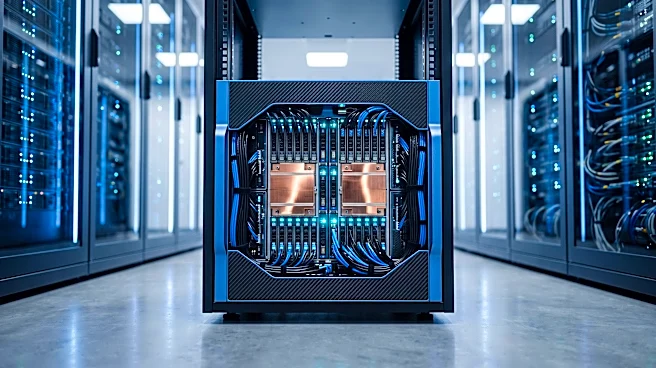

In the rush to scale enterprise AI, the instinct is often to throw more hardware at the problem. But when performance stalls, adding more GPUs is frequently like adding more lanes to a highway where the bottleneck is actually a narrow bridge.
The Illusion of Busy Chips
For years,
the gold standard for measuring AI productivity was GPU utilization. If the chip was running at 90 percent capacity, you assumed you were getting your money's worth. This worked well for training large models, where workloads are massive, predictable, and keep the hardware constantly engaged. However, as enterprises shift from training to inference—the actual act of using the AI to perform tasks—that metric starts to lie. You can have a GPU that is working at full throttle but producing almost nothing of value. This happens because the chip is busy, but it is busy doing redundant work rather than moving the user's request forward.
The Recomputation Trap
One of the biggest culprits in modern AI performance is the 'agentic' workload. Unlike a simple chatbot that answers a single question, an AI agent performs complex tasks over multiple steps. At every step, the agent needs to look back at everything it has done so far. This context requires significant memory. If the system is crowded with many users, the GPU often has to evict that precious context from its high-speed memory to make room for someone else. When the original task returns, the GPU has to recompute everything it just forgot. It is essentially running in circles, burning electricity and processing power to recreate work it has already done. In these scenarios, adding more GPUs doesn't help if the underlying issue is how the system manages and retains context.
Running Out of Seats
Think of an AI model as a train. The GPU's memory is the number of seats available on that train. Every active conversation takes up a certain amount of space to hold the history of the chat. When the memory is full, the train is at capacity. Even if you buy a faster engine (a more powerful chip), you haven't added any more seats. New users are forced into a queue, waiting for a seat to open up. This leads to the dreaded 'try again later' messages or significant delays in response times. In this case, the bottleneck isn't the speed of the computation, but the capacity of the memory to hold the conversation state.
Smart Fixes Over Raw Power
If more hardware isn't the answer, what is? The solution usually lies in efficiency and smarter architecture. One common tactic is using smaller number formats. While scientific simulations often require high-precision 64-bit numbers to avoid errors, many AI models can run effectively on 8-bit numbers. This effectively doubles or even quadruples the 'seats' on the train by using less memory per user without a significant loss in intelligence. Another approach involves better memory management, such as using shared memory tiers that allow the system to retrieve old context without having to recompute it from scratch. By focusing on how data moves and how memory is managed, enterprises can often achieve much better performance than they would by simply buying more silicon.