





Copper: Perfectly Designed for a World of Voices
Before data was king, there was voice. When Alexander Graham Bell patented the telephone in 1876, he needed a way to carry electrical signals reliably and affordably. Copper was the perfect solution. It was highly conductive, malleable, and relatively
cheap, making it the ideal backbone for the Public Switched Telephone Network (PSTN) that would connect the globe. For much of the 20th century, copper's main job was to carry analog voice signals. Its design, particularly the twisted-pair cable common in phone lines, was a clever bit of engineering to reduce electromagnetic interference from outside sources. Each pair of insulated copper wires is twisted together to cancel out noise, ensuring your conversation with someone across the country remained clear. For the task it was built for—connecting voices—copper infrastructure was a triumph of engineering and economics. Its limitations weren't flaws; they were acceptable trade-offs in an analog world.
The Internet Arrives and Pushes Copper to its Limits
Then came the internet, and the demands on that copper infrastructure changed almost overnight. The world shifted from transmitting voice to transmitting massive amounts of data. This is where copper, the hero of the voice age, began to show its strain. The same electrical properties that made it great for voice became major roadblocks for high-speed data. Two key problems emerged: signal attenuation and interference. Attenuation is the natural weakening of a signal as it travels over distance. With copper, this signal loss is significant, limiting cable runs to around 328 feet (100 meters) before the signal becomes too degraded. Furthermore, because copper cables transmit electrical signals, they are susceptible to electromagnetic interference (EMI), or "crosstalk," from nearby power lines or even other cables, which can corrupt the data. While technologies like DSL (Digital Subscriber Line) were clever workarounds that squeezed more data through old phone lines, they were pushing a system to a limit it was never designed to handle. Copper was hitting a hard ceiling.
Fiber Optics: A Highway Built for Light
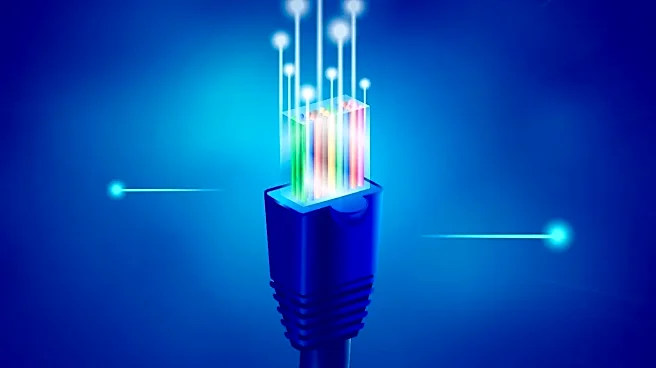
The solution didn't come from improving copper, but from a completely different approach. In 1970, scientists at Corning developed the first low-loss optical fiber, a strand of highly pure glass thinner than a human hair. Instead of transmitting electricity, fiber optic cables transmit data using pulses of light. This fundamental difference is the game-changer. Because light travels through a glass core, it is virtually immune to the electromagnetic interference that plagues copper. Signal attenuation is also drastically lower; a fiber signal loses only about 3% of its strength over 100 meters, while a copper signal can lose up to 94% over the same distance. This allows fiber to carry immense amounts of data over incredibly long distances—sometimes for miles—without needing a booster. It wasn't just an upgrade; it was a new technology built to solve the specific problems of a data-driven era that copper couldn't.
The Real Reason: An Economic Bet on the Future
So, the real reason for the different designs comes down to this: copper was designed to solve a 20th-century problem economically, while fiber was designed to enable a 21st-century economy. Copper wiring was already in the ground, a massive, sunk-cost infrastructure that made sense to leverage for as long as possible. The initial rollout of fiber was, by contrast, an enormous and expensive undertaking. It was a strategic bet that the future would be defined not by voice calls, but by data-heavy applications like cloud computing, high-definition streaming, and eventually, the Internet of Things and AI. That bet has clearly paid off. Deploying fiber is now seen as a critical infrastructure investment that can generate trillions in economic impact by increasing home values, creating jobs, and enabling future technologies. The switch from copper to fiber isn't just about faster downloads; it's a reflection of a fundamental shift in how the world communicates and does business, moving from a system built for scarcity (of bandwidth) to one designed for abundance.