










The Case for a WebSocket World
Many senior engineers argue that WebSockets are not going anywhere, and for good reason. They are a mature, battle-tested technology with widespread browser support. For a huge range of common applications—like live chats, news tickers, and basic notifications—WebSockets
provide a reliable, low-latency, and efficient bidirectional communication channel. After an initial handshake, data can flow freely between the client and server over a persistent connection, which is far more efficient than the old method of constantly polling for updates. This model is event-driven, meaning the server can push data the moment it's available, creating the seamless, real-time experiences users now expect. For many development teams, the robust ecosystem and deep community knowledge make WebSockets the practical, default choice.
The Cracks in the Foundation
Despite their strengths, other experienced engineers point to growing cracks in the WebSocket foundation. Their biggest complaints often revolve around complexity and scale. WebSockets are stateful, meaning the server must maintain an active connection for every single user, which can be resource-intensive and complicates scaling horizontally across multiple servers. If a connection drops, there's no automatic recovery; developers have to build that logic themselves. Another significant issue is "head-of-line blocking." Because WebSockets typically operate on a single, ordered stream over TCP, a single lost data packet can hold up all subsequent messages until it's recovered. This is a major problem for high-performance applications like cloud gaming or financial trading, where one delayed message can't be allowed to stall others.
The Rise of the Alternatives: HTTP/2, HTTP/3, and WebTransport
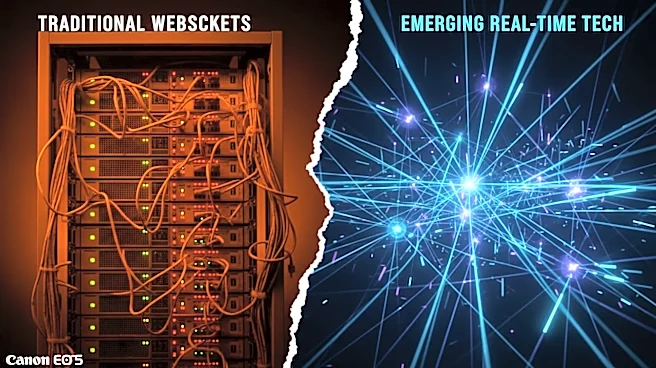
The disagreement is fueled by the arrival of powerful new alternatives. The evolution of the HTTP protocol itself, with HTTP/2 and now HTTP/3, has closed some of the performance gaps that made WebSockets so essential. But the real challenger that has engineers talking is WebTransport. Built on top of HTTP/3 and the QUIC protocol, WebTransport is designed to solve the core problems of WebSockets. It offers multiple independent data streams within a single connection, which eliminates head-of-line blocking. It also supports both reliable data streams (like WebSockets) and unreliable datagrams, which are perfect for use cases like streaming video or game state updates where losing a single packet is better than waiting for it. As of March 2026, WebTransport is now supported by all major browsers, making it a viable, albeit new, contender.
A Specialized Toolkit, Not a Silver Bullet
Ultimately, the debate among senior engineers isn't about one technology "killing" another. It's a reflection of an evolving landscape where developers have more specialized tools. The consensus is that the right choice depends entirely on the use case. WebSockets remain the perfect, easy-to-implement solution for a vast number of real-time applications like chats and dashboards where strict message order and reliability are key. Server-Sent Events (SSE) are even simpler and more efficient for one-way data flows, like news feeds or AI response streaming. WebTransport is emerging as the high-performance choice for complex, latency-sensitive applications that need to manage multiple data types or survive on shaky networks. The disagreement, therefore, is less about the death of WebSockets and more about the end of a one-size-fits-all approach to real-time communication on the web.