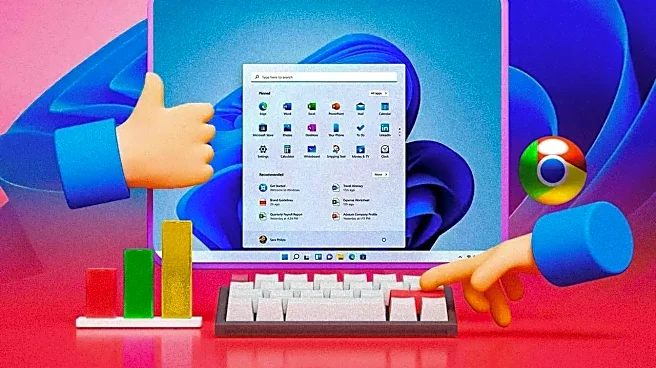






Years after its launch, the legacy of Windows 11 isn't just its centered taskbar or rounded corners. The real story is how its creation forced a fundamental shift in engineering philosophy, leaving lessons that now define modern software development.
Designing for a World That Changed Overnight
More than any Windows version before it, Windows 11 was a direct response to a global shift in how and where people work. Launched in the long shadow of the pandemic, it was engineered from the ground up for a hybrid workforce. This wasn't just about adding a Teams button to the taskbar. It meant prioritizing features that reduce friction for users moving between home and office, like improved docking and support for multiple monitors that remember your window layouts. Productivity features like Snap Layouts and Snap Groups were designed to help users better organize their digital workspace, a direct acknowledgment that the PC was no longer just a work device but a hub for every aspect of life. This 'hybrid-first' mindset became a core engineering principle, forcing developers to think beyond a static office environment and build for flexibility, a lesson that has since been embedded in countless other applications and platforms.
Drawing a Hard Line on Security
Perhaps the most controversial aspect of the Windows 11 launch was its strict hardware requirements, specifically the need for a Trusted Platform Module (TPM) 2.0 chip. While this frustrated many users with older but still capable hardware, it was a deliberate and pivotal engineering decision. Microsoft effectively drew a line in the sand, establishing a new, elevated security baseline for the entire PC ecosystem. The goal was to create a hardware root of trust, making it significantly harder for threats like firmware attacks and ransomware to succeed. By making security features like hardware-based isolation, encryption, and malware prevention on by default, Windows 11 championed a 'secure-by-design' philosophy. This move forced a long-overdue conversation across the industry about the trade-offs between backward compatibility and forward-looking security, a principle now central to a Zero Trust security model.
Embracing a More Agile Development Model
The Windows 10 era was defined by the mantra 'Windows as a Service,' which promised continuous updates but sometimes resulted in unpredictable feature rollouts and user fatigue. With Windows 11, Microsoft refined this approach. While it still delivers regular updates, the cadence became more predictable, moving toward a major annual feature update. This shift was enabled by a matured and restructured Windows Insider Program. Instead of a confusing array of channels, the program was simplified, giving developers and enthusiasts clearer paths to test pre-release builds. This created a more effective feedback loop, allowing engineers to test features, gather real-world data, and iterate more efficiently before a wide release. This model of structured, community-driven testing and validation has become a blueprint for large-scale software projects, balancing the need for rapid innovation with the demand for stability.
Integrating AI at the Core
While AI features have become much more prominent recently, Windows 11 laid the groundwork for their deep integration into the operating system. Intelligent features were introduced to make the user experience more personal and human, using AI for functionalities like voice clarity, background blur in video calls, and automatic framing. Internally, Microsoft's teams began using AI to accelerate their own development processes helping designers contribute directly to code fixes and improve overall quality. This dual approach—using AI to both enhance the end user product and streamline its creation—was a forward looking strategy. It established the OS not just as a platform for running applications but as an intelligent layer that actively assists the user. This foundational work paved the way for the more ambitious AI powered copilots and system level assistants that are now becoming standard in modern computing.