







The Problem: A CPU Can’t Paint a Picture Fast Enough
Cast your mind back to the mid-1990s. 3D video games were the new frontier, promising immersive worlds built from polygons. The problem was that creating these worlds in real-time was a nightmare for computers. A Central Processing Unit (CPU) is a master
of all trades. It’s a brilliant, sequential thinker, tackling complex tasks one after another, like a master chef meticulously preparing a multi-course meal from start to finish. But rendering graphics is a different kind of job. It’s not about one complex task; it’s about millions of simple, repetitive tasks, like calculating the color and position of every pixel on screen. For a CPU, this was death by a thousand cuts. It got bogged down trying to handle everything from game logic to the mind-numbing repetition of drawing triangles. The result was sluggish performance and visual artifacts that broke the immersion. Developers needed a specialist.
The Solution: A Factory of Specialists
The GPU was designed with a completely different philosophy: parallel processing. Instead of a few genius cores, a GPU has hundreds or even thousands of simpler cores that work in unison. Think of it this way: a CPU is a single, highly skilled surgeon performing a complex operation. A GPU is an entire factory floor of workers, each performing one simple, repetitive action simultaneously. For rendering a 3D image, this is revolutionary. One core can calculate the lighting for one pixel while another core calculates the texture for a different pixel, and thousands of others do the same. This division of labor allows a GPU to process massive blocks of visual data all at once, which is why it's sometimes called a 'throughput-optimized' architecture, while a CPU is 'latency-optimized'. In 1999, NVIDIA marketed its GeForce 256 as the 'world’s first GPU', a term it coined to emphasize that this chip could handle the complex geometry and lighting calculations (known as transform and lighting) entirely on its own, freeing the CPU to run the rest of the game.
The 'Aha!' Moment Beyond Gaming
For years, the GPU was seen as a tool for gamers and graphic designers. But in the mid-2000s, researchers in other fields had a realization. The brute-force parallel processing that made games look beautiful was also perfect for other incredibly complex, repetitive calculations found in scientific computing, financial modeling, and data analysis. Suddenly, the 'Graphics' Processing Unit became a General-Purpose GPU (GPGPU). Scientists discovered they could adapt its architecture to simulate weather patterns, analyze protein folding, or run massive financial risk simulations far faster than on a CPU-only system. The factory of specialists, originally built to paint pixels, could be retrained to crunch any kind of number-heavy, parallelizable problem. This revelation laid the groundwork for the GPU's second, and arguably more impactful, life.
The Engine of the AI Revolution
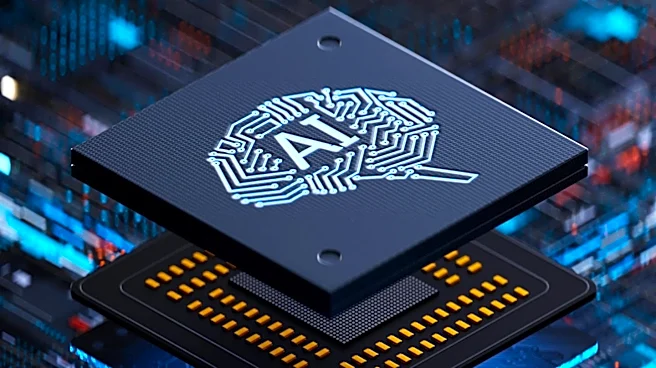
The real, world-altering payoff for the GPU's design came with the rise of modern artificial intelligence. Training a deep learning model, the kind that powers everything from chatbots to self-driving cars, involves feeding it enormous datasets and performing billions of matrix multiplications—a highly repetitive, parallelizable task. Does that sound familiar? It’s the exact type of workload the GPU was built for. Training a large AI model on a CPU could take weeks or months, but a cluster of GPUs can slash that time to days or even hours. This dramatic acceleration didn't just make AI development faster; it made it possible. The very design principle—a massive army of simple processors working in unison—that was conceived to solve a 3D gaming problem in the 90s turned out to be the perfect architecture to unlock the AI revolution of the 21st century.