





Beyond Lumens and Kelvin
When you shop for lighting, the two most prominent specs are lumens (brightness) and Kelvin (color temperature). It’s easy to assume that a brighter light is a better light, but that’s only part of the story. Think of it like food: calories and temperature tell
you something, but they don't tell you anything about nutritional value or flavor. Lumens and Kelvin are the 'calories' and 'temperature' of light. They are simple metrics that are easy to measure and market, but they completely ignore the most crucial element for looking great on camera: light quality.
The CRI Secret: Capturing True Color
The first 'secret' spec is the Color Rendering Index, or CRI. It's a scale from 0 to 100 that measures how accurately a light source reveals the true colors of an object compared to natural sunlight. Have you ever tried on clothes in a dim store fitting room, only to find they look completely different outside? That’s a low CRI problem. Inexpensive LEDs, like those in many budget ring lights, often have a low CRI (typically below 80). This can make skin tones look pasty, sickly, or just plain 'off,' even if the light is bright and the right color temperature. Professional video lights aim for a CRI of 95 or higher, ensuring that reds look rich, blues look vibrant, and your skin looks healthy and natural. This single factor is often the biggest differentiator between a cheap light and a professional one.
The Power of 'Soft' Light
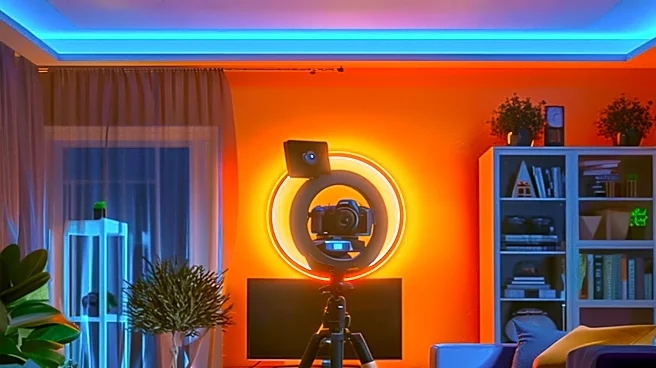
The second, and perhaps more important, factor is the quality of 'softness.' Light isn't just bright or dim; it's also 'hard' or 'soft.' Hard light comes from a small, direct source (like a bare bulb or the sun on a clear day) and creates sharp, defined, and often unflattering shadows. It accentuates every wrinkle, bump, and imperfection. Soft light, by contrast, comes from a large, diffused source (like the sun on an overcast day or a professional softbox). It wraps around your face, smooths out skin texture, and creates gentle, flattering shadows. A standard ring light, despite its size, acts as a relatively hard light source because it’s a direct, un-diffused ring of LEDs pointed at your face, which is why it can still create harsh results.
Why the Light's Size Really Matters
This brings us to the core principle: the larger the light source is relative to the subject, the softer and more flattering the light will be. This is why professional photographers and videographers use massive softboxes. A softbox is essentially a big tent with a diffuser fabric on the front; you put a powerful light inside, and the entire front panel becomes the new, much larger light source. This creates that beautiful, soft, wraparound light seen in interviews and high-end YouTube videos. A small, 12-inch ring light a foot from your face is still a small light source. But a two-foot by three-foot softbox placed a few feet away is a massive source by comparison. It’s this difference in the effective size of the light, not just its brightness, that separates amateur video from a professional look.