





First Off, What's a DCGAN?
Let’s demystify the alphabet soup. DCGAN stands for Deep Convolutional Generative Adversarial Network. It sounds intimidating, but the core idea is surprisingly intuitive. In 2015, a group of researchers unveiled this specific type of AI model that was
exceptionally good at one thing: creating images from scratch. Before DCGANs, AI-generated images were often blurry, chaotic messes. DCGANs were a breakthrough because they could produce sharp, coherent, and often photorealistic images, most famously of human faces that don't actually exist. Think of it as the moment AI went from abstract artist to a skilled, if sometimes strange, portrait painter. This wasn't just an improvement; it was a leap that laid the groundwork for the generative AI explosion we see today.
The Forger and The Detective
The magic behind DCGANs—and all GANs—is a clever cat-and-mouse game played by two dueling neural networks. Imagine an art forger (the “Generator”) trying to create a fake Picasso. At the same time, there's an art expert (the “Discriminator”) whose job is to tell the difference between a real Picasso and the forger's fakes. At first, the forger is terrible, and the expert easily spots the counterfeits. But with every failure, the forger learns from its mistakes and gets a little better. In response, the expert has to get smarter at spotting more sophisticated fakes. This adversarial process continues, with both networks pushing each other to improve, until the forger becomes so skilled that the expert can no longer reliably tell the difference between the real thing and the fake. At that point, the Generator is skilled enough to create convincingly real images on its own.
More Than Just Fake Faces
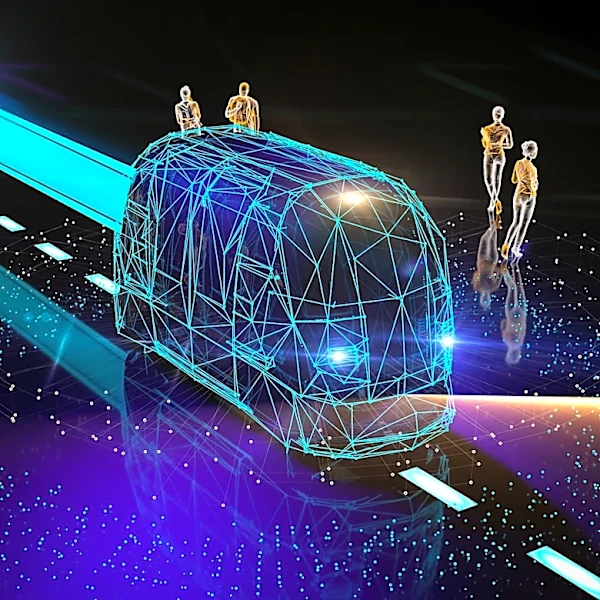
While generating endless streams of non-existent people was a fascinating party trick, the true impact of DCGANs was never about fooling your friends. The underlying technology opened up powerful new capabilities. Companies realized they could use this to create synthetic data. Need to train a self-driving car’s computer vision? Instead of driving millions of miles, you can generate millions of realistic but artificial road scenarios. This is cheaper, faster, and allows for the creation of rare edge cases (like a deer jumping out at dusk) on demand. The same principle applies to medical imaging, where synthetic scans can help train diagnostic AI without violating patient privacy. It also became a foundational tool for creative industries, enabling everything from style transfer (making a photo look like a Van Gogh painting) to the early precursors of today's AI art generators.
The Real Prediction: A World of Synthetic Media
So, what does this nine-year-old technology predict for the *next* decade? DCGAN is the Wright Flyer to the Boeing 787s of today’s AI models like DALL-E, Midjourney, and Sora. It doesn't predict a specific stock market crash or election outcome. It predicts a world where the line between real and generated content becomes increasingly blurred, and in many cases, irrelevant. The next decade will see this technology become deeply embedded in our daily lives. Expect hyper-personalized advertising where the models in the photos are generated to look like you. Movies will use AI-generated sets or de-age actors flawlessly. Video games will create vast, unique worlds on the fly. On the darker side, it predicts a continued struggle with deepfakes, misinformation, and the challenge of maintaining a shared, verifiable reality. The most accurate prediction from DCGAN isn't an event; it's a condition: We are entering an era where anything that can be imagined can be rendered, for better or for worse.