







An Empire Built on Thumbs
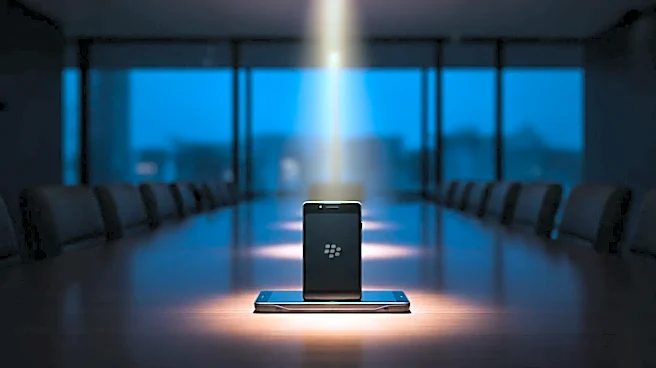
In the mid-2000s, to own a BlackBerry was to be important. Its physical QWERTY keyboard was the gold standard for executives, politicians, and anyone who needed to fire off emails on the go. Armed with the lightning-fast BlackBerry Messenger (BBM) and fortress-like
security that made it a darling of corporate IT departments, the company, then known as Research In Motion (RIM), seemed untouchable. Its market share soared, peaking at around 50% of the U.S. smartphone market in 2009. The device was so addictive it earned the nickname "CrackBerry," a testament to its cultural and professional dominance. The company’s leaders, Mike Lazaridis and Jim Balsillie, had built an empire by perfectly serving the needs of the business world. They believed this focus on security and productivity was an impenetrable moat.
A Glass Screen Changes the World
When Apple unveiled the iPhone in 2007, BlackBerry's leadership was publicly dismissive. They saw a consumer toy that lacked a physical keyboard, a perceived necessity for their core business users. What they failed to grasp was that the iPhone represented a fundamental paradigm shift. It wasn't just a phone; it was a powerful, pocket-sized computer centered around a vibrant ecosystem of third-party applications. The launch of the App Store in 2008 supercharged this new model. Suddenly, a phone’s value wasn't just about email and security, but about what it could do—from playing games to navigating maps to social networking. This “consumerization of IT” meant employees began bringing their preferred personal devices to work, dismantling the corporate stronghold BlackBerry had built from the inside out.
The Billion-Dollar Gamble
As its market share began to bleed away to iOS and the rapidly growing Android platform, BlackBerry faced an existential choice. Its own operating system was aging poorly and wasn't designed for the new world of touchscreens and apps. The obvious, pragmatic move would have been to adopt Android, leveraging its ready-made ecosystem while focusing on BlackBerry's hardware and security strengths. But they chose a different path. This was the hidden decision: instead of joining the Android army, BlackBerry decided to build a brand-new, modern operating system from the ground up. In 2010, the company acquired QNX Software Systems for $200 million with the goal of using its robust, reliable code as the foundation for a savior. They would call it BlackBerry 10.
Building a Masterpiece That Nobody Wanted
The decision to build BlackBerry 10 was a bet-the-company move, driven by a belief that they could create a superior experience by controlling the entire stack, just like Apple. On a technical level, they arguably succeeded. When BlackBerry 10 finally launched in January 2013, the OS was praised for its innovative, gesture-based interface and true multitasking capabilities. Based on the industrial-grade QNX kernel, it was incredibly stable and secure. But it had one fatal flaw: it was catastrophically late. By 2013, the war was already over. The iOS and Android app ecosystems had become gravitational forces, attracting millions of users and developers. BlackBerry 10, despite its technical elegance, launched into a world with a massive "app gap" it could never close. Developers wouldn't build for a platform with few users, and users wouldn't buy a phone with few apps. The decision to build their own OS had burned through billions of dollars and, more importantly, years of precious time they could never get back.