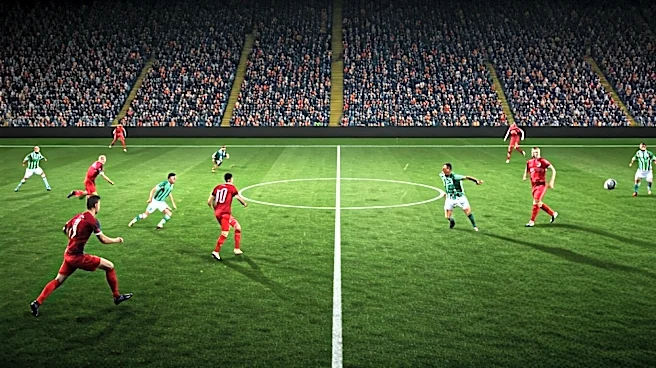




What Is a Switch of Play?
At its core, a switch of play is simple: moving the ball quickly from one side of the field to the other. Imagine the field split vertically down the middle. A switch is any action designed to transfer the point of attack from the left half to the right, or vice versa. While this can be done with a series of quick, short passes, the most dramatic and effective version is the long, raking diagonal pass. It’s not just a hopeful punt; it’s a calculated, high-skill maneuver designed to catch a defense off-balance. The goal is to find a teammate in open space on the opposite flank, instantly changing the picture of the attack and forcing the entire defensive unit to react.
The Setup: Baiting the Trap
A great switch of play doesn't happen in a vacuum. It begins with a deliberate
setup. The attacking team will often “overload” one side of the field, sending their midfielder, full-back, and winger to combine in a tight area. This is the bait. A defending team’s natural instinct is to shift its entire block of players toward the ball to stay compact, prevent passing lanes, and win back possession. They get drawn toward this cluster of activity, concentrating their numbers and leaving the opposite side of the field—the “weak side”—dangerously underpopulated. This is exactly what the attacking team wants. They have successfully lured the defense into a congested corner of the pitch, setting the stage for the main event.
The Payoff: Creating Space and Chaos
This is where the “stretching” happens. Once the defense is compressed on one side, a player with great vision and technique launches a long pass to the weak side. Suddenly, a winger who was standing in acres of space is now running at a single, isolated defender. The entire defensive line, which was just moving as a coordinated unit to its left, now has to slam on the brakes and sprint 40 or 50 yards to its right. This frantic horizontal scramble is a nightmare for defenders. It shatters their compact shape, opens up channels between the center-back and full-back, and creates panic. A ball can travel across the field in two seconds; no defensive line can reposition itself perfectly in that time. This moment of chaos is where scoring opportunities are born.
Why It’s So Effective
The effectiveness of the switch is rooted in simple physics and psychology. First, it forces the defense to cover the maximum width of the field, which is exhausting and mentally taxing. Second, it creates advantageous one-on-one situations. Instead of trying to dribble through a thicket of three defenders, an attacker gets to face a single opponent who is often backpedaling and exposed. Psychologically, it disrupts the rhythm of a defense. A team that feels comfortable and in control can be instantly thrown into disarray, forced to communicate frantically and track runners across a vast space. This pressure often leads to mistakes—a missed tackle, a blown assignment, or a gap left unplugged—that a top-level attack will ruthlessly exploit.
Masters of the Diagonal Ball
Certain players become famous for their ability to execute this pass. Think of Liverpool’s Trent Alexander-Arnold, whose cross-field passes to an advancing Andy Robertson or Luis Díaz became a signature weapon of Jürgen Klopp’s system. For years at Real Madrid, Toni Kroos acted as the team’s quarterback, effortlessly spraying 60-yard passes to the flank to initiate attacks. Going further back, English icons like David Beckham and Paul Scholes built legendary careers on their almost supernatural ability to see and execute the switch of play. These players don’t just kick a ball; they scan the entire field, process the defensive shift, and deliver a perfectly weighted pass that completely changes the terms of engagement.