




Starting the Drive: The Buildup
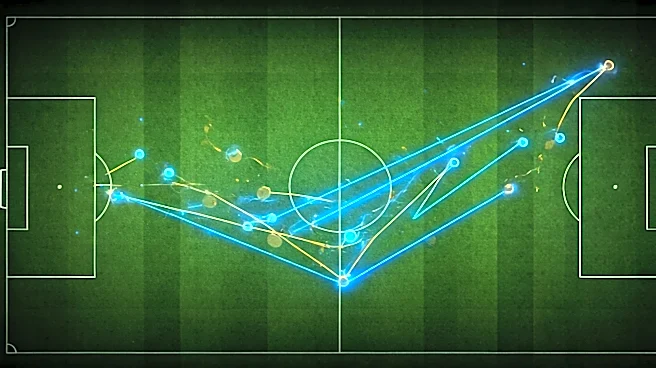
Every great drive starts deep in your own territory. Think of a team taking over at their own 20-yard line after a punt. The first few plays aren’t about scoring a touchdown; they’re about establishing rhythm, gaining breathing room, and safely moving the ball forward. This is the “buildup phase” in soccer. When a goalkeeper rolls the ball to a central defender, they aren’t just kicking it. They are initiating a sequence. The goal is to circulate the ball across the back line, drawing the opponent's forwards out of position and creating safe, simple passing lanes into the midfield. It’s the equivalent of a few three-yard runs to set up a manageable second and third down. The priority is ball security—a turnover here is a pick-six.
Crossing Midfield: The First Down Mentality
In football,
the field is divided by yellow lines and the singular goal of getting ten yards. Each first down is a mini-victory, a reset that brings you closer to scoring territory. Soccer has an invisible equivalent: breaking the opponent's lines of pressure. A “progressive pass” in soccer is any forward pass that bypasses opponents and advances the ball significantly. It’s a first down. A midfielder receiving the ball between the opponent's forwards and midfielders, then turning to face their goal, has just moved the chains. A winger dribbling past their defender on the sideline is like a running back breaking into the secondary. The objective is the same: gain territory, destabilize the defense, and move from your half of the field into theirs, where the real threats can begin.
The Playbook: Patterns and Improvisation
While football plays are discrete events that stop and start, soccer’s “plays” unfold in real-time. But they are just as rehearsed. Coaches drill attacking patterns relentlessly. An overlapping run from a fullback is a designed route meant to create a 2-on-1 advantage on the wing, just like a pick play in the NFL frees up a receiver. A quick one-two pass (a “give-and-go”) is soccer’s version of a screen pass, designed to pull defenders one way and attack the space they vacate. The key difference is the improvisation required. A soccer player has to read the defense and execute their “route” based on fluid movement, whereas a quarterback has a few seconds of pre-snap certainty. Still, the underlying principle holds: create a numerical or positional advantage through rehearsed, coordinated movement.
Entering the Red Zone: The Final Third
When an offense crosses the 20-yard line in football, everything changes. The field shrinks, the defense becomes hyper-aggressive, and every decision is magnified. Welcome to soccer’s “final third.” This is the attacking portion of the field, roughly 30-35 yards from the opponent’s goal. Once the ball enters this zone, the attacking team’s mentality shifts from possession to penetration. The passing becomes quicker and riskier. Players make sharp, decisive runs into the penalty box. The entire defensive team condenses, trying to block passing lanes and shut down space. Just as a football team’s red zone efficiency is a key metric, a soccer team’s ability to generate high-quality shots from the final third determines whether they are a championship contender or a team that just passes it around nicely.
Scoring the Touchdown: Creating the Shot
A 99-yard drive is worthless if you fumble on the one-yard line. The same is true in soccer. All the beautiful buildup play means nothing without the final, decisive action: the shot. The pass that leads directly to a shot is called a “key pass,” and it’s soccer’s version of the throw to the end zone. It could be a perfectly weighted through-ball that splits the defenders for a striker to run onto, or a cross whipped in from the sideline for a forward to head into the net. This is the moment of execution. Advanced stats like “Expected Goals” (xG) even measure the quality of a scoring chance, much like football analytics measure the probability of success on a fourth-and-goal. The goal isn’t just to shoot; it’s to execute a sequence that creates an undeniable, high-percentage opportunity to score.