
The Numbers, Decoded
At its most basic, a soccer formation is a numerical code for how a team arranges its players on the field. The numbers, read from back to front, represent defenders, midfielders, and forwards. A classic
4-4-2, for instance, means four defenders, four midfielders, and two forwards. A modern, attack-minded 4-3-3 signifies four defenders, three midfielders, and three forwards. The goalkeeper is the unspoken '1' who is never counted. For decades, this was a simple, effective way to understand a team's general philosophy. A formation with five defenders (like a 5-3-2) suggests a defensive, cautious approach. One with only three defenders (like a 3-4-3) screams attacking intent, a willingness to risk it all. On paper, it’s a clean, organized snapshot of a team's identity before the first whistle blows. It’s the game plan drawn up on the whiteboard, clear and simple for everyone to see.
The Promise of the Plan
This is where the "system sheet" analogy really clicks. Just as a basketball coach draws up a play to get a shooter an open look, a soccer formation outlines the team's initial strategy. It’s a statement of intent. A 4-4-2 promises balance and control of the flanks. A 4-2-3-1, with its two defensive midfielders, is built for stability in the center of the park and quick counter-attacks. A 3-5-2 aims to overwhelm the opponent in midfield and provide width through its wing-backs.
These numbers give fans and analysts a framework for discussion. If a team playing a 4-3-3 is getting dominated, the first question is often tactical: Are the midfielders being overrun? Are the wingers tracking back? The formation provides the blueprint against which the live action is judged. It sets expectations for where players should be and what their primary responsibilities are, giving the beautiful game a sense of order amidst the chaos.
Where the Sheet Crumbles
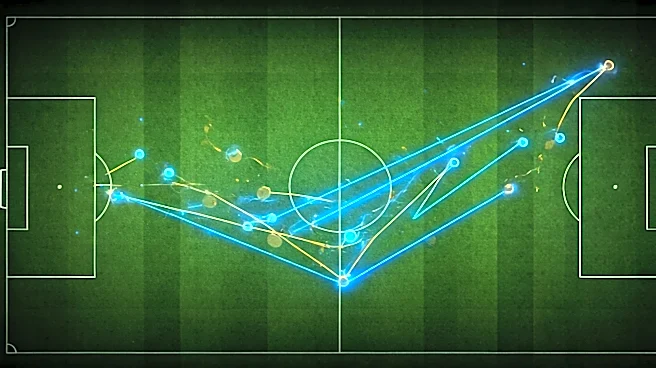
Here's the secret: the formation you see on the graphic before kickoff is a lie. Or, more charitably, it’s a suggestion. The moment the ball moves, those neat lines and numbers dissolve into a fluid, ever-changing reality. Soccer is not a static game; it’s a game of phases.
A team's shape when it has the ball (in possession) is often completely different from its shape when it's trying to win it back (out of possession). That attacking 4-3-3 that looked so bold on paper? When the other team has the ball, the two wingers will often drop back to help defend, instantly transforming the shape into a much more compact, defensive 4-5-1. The system sheet didn't account for that, but it's the key to how modern soccer works. The best teams are chameleons, morphing their shape based on the specific situation.
The Modern Game: Principles over Positions
Top-tier coaches today talk less about rigid formations and more about “principles of play” and “occupying spaces.” For a manager like Manchester City's Pep Guardiola, a player's starting position on the teamsheet is secondary to the roles they perform. He might deploy a “full-back” who spends most of the game drifting into central midfield (an “inverted full-back”), completely breaking the traditional rules of the 4-3-3 he supposedly started with.
Players are no longer just defenders or midfielders; they are multi-functional athletes tasked with executing complex instructions. The question is no longer “Are you a left-back?” but rather, “Can you control this specific zone of the field when we have the ball, and can you press the opponent in that zone when we lose it?” The formation numbers can’t capture this level of tactical sophistication. They're a 2D map for a 3D, fast-moving game.