
The Stillness Before the Storm
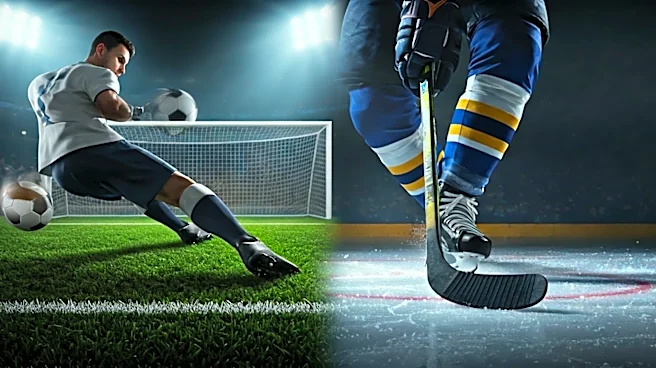
Both soccer and hockey are defined by constant, flowing motion. They are games of improvisation, reaction, and fluid transitions. A set piece in soccer (a free kick or corner kick) and a faceoff in hockey are rare
exceptions. They are moments of manufactured stillness—the only time coaches get to stop the game, huddle their players (metaphorically or literally), and call a pre-designed play. Everything pauses. The chaotic, flowing nature of the game is temporarily suspended, replaced by a single, focused objective. This shared starting point—a dead-ball or dead-puck situation—is the foundation of their similarity. It’s a brief, precious window where a coach’s whiteboard diagram can be brought to life.
The Five-Second Chess Match
Consider a crucial offensive-zone faceoff in the final minutes of a hockey game. It’s not just about the center winning the puck back. That’s just step one. A well-designed play has multiple layers. The center might try to win it cleanly to the defenseman at the point for a quick shot. But watch the other players. The winger on the boards might be there to block an opponent trying to pressure the defenseman. Another forward is bee-lining for the front of the net, not to get the puck, but to create a screen, taking away the goalie’s eyes. The other winger might be cheating toward a “soft spot” in the defensive coverage, anticipating a rebound or a deflection. It’s a five-second play with four or five distinct, coordinated jobs, all designed to create one high-quality scoring chance from a static start.
An Orchestra of Deception
Now, think about a corner kick in soccer. It’s the exact same principle, just on a larger green stage. The player taking the kick is the quarterback. But the real action is the synchronized chaos in the penalty box. One player makes a hard run to the near post, drawing two defenders with him and clearing out space behind. Another player, often a big central defender, starts his run from deep, timing it to attack the newly created space with a full head of steam. A third player might act as a blocker, subtly impeding the goalkeeper or a key defender. A fourth might peel away to the top of the box, waiting for a cleared ball to volley back toward goal. Just like in hockey, it’s not about one player trying to do one thing. It’s a multi-layered, deceptive play where decoy runs are just as important as the intended target. The goal is to create a mismatch or a moment of defensive confusion.
The Shared DNA: Geometry and Misdirection
Here’s where the two plays feel uncannily alike. Both are about manipulating space and creating favorable geometry. Winning the puck back to the point defenseman in hockey is the same as playing a corner kick to the player at the top of the 18-yard box; it’s about using the 'quarterback' to initiate an attack from a position with a full view of the chaos. The player screening the goalie in hockey is performing the same function as the player making a decoy run to the near post in soccer—their job is to occupy defenders and create an advantage for someone else. In both sports, these plays rely on a primary threat (the shot, the header), a secondary threat (the rebound, the second ball), and a network of support players whose only job is to enable those threats through blocks, screens, and misdirection. They are both a test of coaching, discipline, and execution under pressure.