







The Unspoken (and Spoken) Rulebook
To understand why sneakers at Cannes are a big deal, you first have to understand the festival’s near-mythical dress code. Ascending the iconic 24 steps of the Palais des Festivals for a premiere screening is not a casual affair. For men, the rule is black-tie, no exceptions. For women, it’s evening gowns and, for the longest time, an unwritten but ruthlessly enforced expectation of high heels. This isn't just a suggestion; it's part of the event's DNA, a performance of old-world glamour and exclusivity. The festival has always been a place where fashion is a serious, regulated sport. To deviate is not just a fashion faux pas; it’s seen as an act of disrespect to the institution itself. Security has, on many occasions, acted as fashion police,
scrutinizing footwear with the intensity of airport screeners.
Heelgate and the First Cracks
The tension finally snapped in 2015. News broke that a group of women in their 50s, some with medical conditions, had been denied entry to a screening of *Carol* for wearing rhinestone-adorned flat shoes. The resulting outrage, dubbed “Heelgate,” became an international incident. Celebrities pushed back. The following year, Julia Roberts walked the red carpet entirely barefoot in a symbolic protest. Kristen Stewart, a repeat offender of the flats “rule,” famously took her Christian Louboutin heels off right on the steps in 2018, holding them in her hands as she ascended. These weren’t just moments of celebrity quirk; they were deliberate challenges to a code that many saw as archaic and sexist. They cracked the pristine façade of Cannes tradition, creating an opening for a new kind of red carpet statement.
From Sandler to Spike Lee
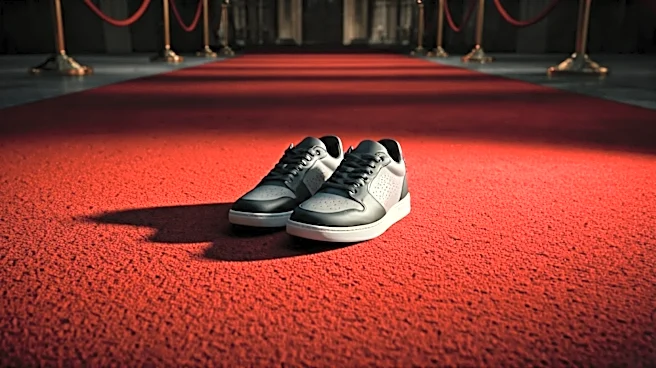
While women were fighting for the right to wear flats, men started using footwear to redefine formalwear. Enter Adam Sandler, the patron saint of red carpet comfort. His repeated appearances in baggy suits paired with chunky athletic sneakers are less a protest and more a consistent statement of his personal brand: he’s just not playing the game. But the trend evolved beyond just comfort. In 2018, jury president Spike Lee made a powerful statement by pairing his tuxedo with a custom pair of gold Nike Air Jordan 1s. This wasn't just a sneaker; it was a piece of cultural iconography, a nod to streetwear's global dominance, and a personal signature. It proved that sneakers could be just as much of a statement piece as a diamond necklace or a bespoke suit.
Where Streetwear Meets Couture
Today, the sneaker’s presence at Cannes is no longer just an act of rebellion; it’s a reflection of the fashion industry itself. The line between high fashion and streetwear has evaporated. Luxury houses like Dior, Chanel, and Louis Vuitton have their own multi-thousand-dollar sneaker lines. When a celebrity wears a pair of Virgil Abloh-designed Off-White Nikes or Balenciaga’s infamous Triple S sneakers with a tuxedo, they aren’t dressing down. They are participating in the new luxury. The sneaker has become a status symbol, a canvas for artistic collaboration, and a bridge between the exclusive world of couture and the accessible energy of street culture. What seemed unthinkable a decade ago is now an accepted, even celebrated, part of the red carpet lexicon. It’s a sign that celebrity influence and the power of personal branding have finally become stronger than the festival’s old-world rules.