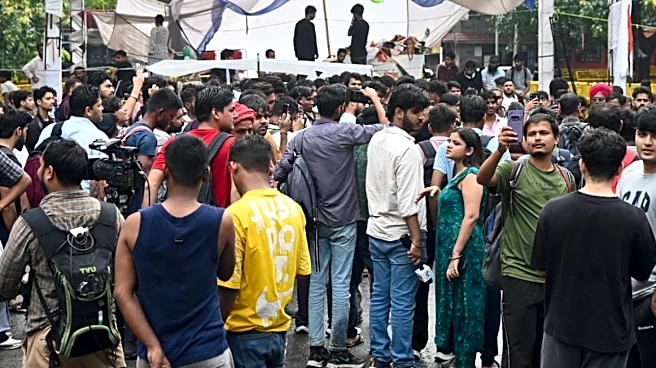
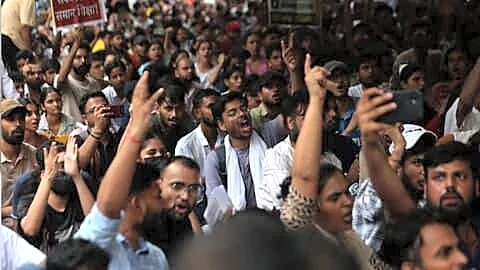
(These are four personal accounts, published as submitted. Descriptions of specific incidents on the ground reflect what each contributor says they witnessed or saw circulating on social media, and have not been independently verified by Times Now Digital. Where allegations are made about the conduct of police or protesters, they remain allegations.)The setting: On July 20, the opening day of the Monsoon Session, thousands gathered at Jantar Mantar for the Cockroach Janta Party's "Sansad Chalo" march. Police had denied permission to march to Parliament. By late morning, forces used a baton charge and tear gas near Parliament Street after protesters allegedly tried to push through barricades. Police later put the injury count at over protesters and personnel
combined; DCP Sachin Sharma said no police personnel had used force, while the CJP alleged the opposite. The core demand has not moved: theresignation of Union Education Minister Dharmendra Pradhan over the NEET 2026 paper leak, an exam taken by over two million students for roughly 1.3 lakh seats, which had to be held again. Sonam Wangchuk, hospitalised on the 21st day of his hunger strike, said he would extend his fast after the police action. Protest organisers have also linked the exam controversy to serious psychological distress among aspirants.That's the record. Here's the argument.Contributors are identified asSudhanshu MishraandPoorvaKarki, who are speaking in favour of the CJP protest; and Ananya Varma and Surbhi Kaul against the protest.
1. Is the cause enough?
Poorva: Even if one is not in support of the faces, names and organisations leading the protest, the cause is way bigger than any individual anyway. It is simple: accountability from the ones who were supposed to run the nation. Demanding Pradhan's resignation over the NEET leak, while he is Education Minister, is not new to India. Lal Bahadur Shastri resigned as Railway Minister over the Ariyalur train disaster.
Sudhanshu: It isn't just about the paper leak. Yes, it started as that, and it is sticking to the cause — but people are filled with frustration, and this stage gives it momentum. Students from elite Delhi schools unaffected by NEET came out calling it their "moral duty", frustrated with a system where youth have no say in decisions that affect them. From the three-language policy to ethanol blending affecting vehicles, to the farm laws and women's reservation, this government decides without consultation. That is the protest's central message.It simply argues that India has always been larger than its governments. Larger than its parties. Larger than the ambitions of those who mistake an electoral mandate for permanent ownership of a nation. They imagine it is about a policy, a bill, an election. It rarely is. At some point it becomes about individual dignity. About refusing to accept that citizenship means obedience. About insisting that the distance between the ruler and the ruled has not become so vast that one can no longer hear the other.
Ananya: Supporting a cause does not mean every action taken during a protest is beyond criticism in the name of a movement.
Surbhi: I support the demand for accountability. I support asking questions about the leak. But that does not mean I have to defend every single thing that happens in its name. A movement is judged not only by its cause but by how it is conducted.
2. Who owns a protest — the names on stage or the people on the street?
Sudhanshu: The average Indian has become remarkably good at doubting a protest before understanding it. When people gather against the establishment, our first instinct is rarely to ask
why. We ask
who. Who is organising it? Who is funding it? Which celebrity showed up? Which party benefits? Which placard went viral?One may disagree with (Abhijeet) Dipke, Wangchuk, (Kunal) Kamra and (Arundhati) Roy over their politics or methods. But reducing a protest to the public figures attached to it ignores the thousands who arrive with concerns that existed long before those names entered the conversation. No Arundhati Roy, no Kunal Kamra, no Shabana Azmi is answerable for an education system riddled with paper leaks. To believe everyone on Delhi's streets was brainwashed, or to call them "anti-national", is to infantilise the intellect of the common people and ridicule their problems – people who skipped classes, applied for leave and booked tickets to be there.
Ananya: There were undoubtedly many genuine protesters with peaceful intentions. But as often happens in large demonstrations, some individuals appeared to engage in violence that overshadowed the protest itself. There was also confusion on the ground about where protesters were meant to assemble. With prominent leaders like Dahiya and Dipke surprisingly absent from the march, there seemed to be a lack of clear leadership and coordination, making it easier for the situation to spiral and for disruptive elements to take advantage.
Surbhi: Faces who had been leading the movement online were not visible during the march. Whether that contributed to the confusion is a fair question.
Context: Abhijeet Dipke said on July 21 that he would not lead another march to Parliament, saying doing so would expose young protesters to further police action. A CJP spokesperson has said he was neither detained nor arrested.They almost meet here. Both sides say the movement is bigger than its famous names. One concludes the leaders shouldn't be used to discredit it; the other, that the leaders should have been there to hold it together.
3. The barricade, and the force used at it
Surbhi: The protest was not permitted beyond a certain point. Despite that, protesters moved towards Parliament, barricades were breached, and once that happened, confrontation with police became almost inevitable.
Ananya: They were allowed up to Kerala Bhawan. Moving beyond the designated area, breaching barricades and confronting police after permission limits had been set made the situation far harder to control. Some protesters resorted to stone-pelting and physical force, injuring students and police personnel alike. Every injury is unfortunate, regardless of who suffered it. Security forces should always exercise maximum restraint, but restraint cannot mean doing nothing when barricades are breached, orders are ignored, or officers are attacked. Force must be necessary and proportionate.
Poorva: Then look at who was enforcing that line. CCTV footage of uniformed men breaking car windows with
lathis has come forward. Men in uniform with no name tags is another issue. Why are cops without name tags being allowed into a protest from the government's side? On what basis are civil-uniformed cops "on duty" and charging at protesters? Aren't they simply civilians if they are not in uniform? And if they are civilians, on what basis are they, forget being violent, even asking protesters to leave when protesters have a democratic right to protest and a random civilian cannot stop them?And doctors have recalled on video how cops beat up injured protesters who were being treated. Hitting people while they are being treated, when they are not violent and not crossing barricades — is that correct?
Surbhi: Do I think every police action was justified? No. Disproportionate force must be held accountable. But why is the conversation only one-sided? I saw videos of police being surrounded, stones thrown, officers assaulted. If those videos reflect what happened, how are those actions any more acceptable? Accountability cannot become optional because someone is protesting.
4. The assault on journalists
The two contributors, who were critical to this issue, raised these concerns, and the ones rooting for the protest had a collective response.
Ananya: Videos also showed protesters heckling journalists who were simply asking questions and reporting from the ground. How is that part of a peaceful protest? You switch on your TV expecting updates, and when reporters are doing exactly that, you call them "godi media", hurl abuse and heckle them. I don't understand how that can be defended.
Surbhi: Since when did asking questions become a crime? You cannot demand transparency from the government while refusing to answer journalists. You cannot expect the media to cover your movement and then abuse every reporter who doesn't echo your narrative. If you want your protest seen and heard, you have to tolerate scrutiny. That's how democracy works.
Sudhanshu and Poorva have a counter: Assault on anyone — journalist or not — is wrong. But it is worth asking what produced this anger. For nearly a month, students protesting the NEET paper leak drew little attention from the press. When the cameras finally arrived, they arrived with a script: Monday's front pages and prime-time "specials", complete with CGI visuals, were less about what the students were demanding than about hunting for a hidden motive behind the protest (Read the Pakistani link). The silence had already told the protesters how much the fourth pillar cared about it. Being booed off the site was not an attack on journalism. It was a verdict on a certain type of journalism.
5. The government's silence — where all four converge
Sudhanshu: The government's complete refusal to acknowledge the CJP protests and Wangchuk's 21-day fast is precisely what brought thousands of students out. The PM made no mention of the protests in his media address that same day, despite students protesting metres away. The government refuses to ask Dharmendra Pradhan to resign despite lakhs of students and families affected, treating public sentiment as something to be managed and allowed to slide away over time rather than respected. And it only responds to sustained pressure — in all these years it has buckled only once, on the farm laws, after prolonged protests. Students see the street as the only language this government understands.
Poorva: Getting to
meet a minister to
hand over demands after over 45 days of protest in the heart of the nation is simply not enough action from the ones responsible for all this. This isn't the only protest in India – just the one with the most limelight – and it still has no concrete solution.
Surbhi: The silence has undoubtedly added to the anger. Ignoring young people anxious about their future is neither wise nor responsible. But anger cannot become an excuse for violence, nor can law and order become an excuse for excessive force. Both can be true at once.
Ananya: The silence likely contributed to the frustration. That does not justify violence in the name of a cause.
6. What was gained, and what was lost
Poorva: Students from families that could hardly afford anything gave the exam, only to be told to give it again and spend on travel again. If basic decency and sympathy cannot be shown for them, then maybe some selfishness is what's required: half-baked, half-knowledgeable students – those who clear an exam through a compromised paper rather than on merit – are the future doctors of India. Will you want to be treated by them? India's air, water and food are already desperate to make you very ill in the coming years. Genuine doctors are what will be needed.
Surbhi: What frustrates me most is that the real issue has been overshadowed. Instead of students, accountability or reforms, everyone is talking about lathicharges, clashes and viral videos. Protesters were injured. Police were injured. Journalists were heckled. Attention shifted away from the issue that brought everyone onto the streets. That's not what a successful protest looks like.
Ananya: Both sides walked away injured, and that alone reflects a breakdown that should concern everyone. With clearer communication, responsible leadership, adherence to protest conditions and a more effective response from authorities, perhaps this could have been avoided. Peaceful protest is a democratic right; law and order is a state responsibility. Neither should come at the cost of lives and safety.
The words both sides used
Ananya: Accountability should apply to everyone — those giving orders, those enforcing them, and those protesting. Supporting a movement should not require overlooking unlawful actions by any side.Surbhi: Students deserve answers, and everyone involved must be held to the same standard. If accountability only applies to people we disagree with, then it isn't accountability at all.
Poorva: The cause is rather simple. Accountability from the ones who were supposed to run the nation.Same word. The disagreement is about where the list of names stops.
Reading the argument
What all four agree on. The NEET 2026 paper leak was a failure of governance, and students are owed answers. The government's silence deepened the anger rather than defusing it. Excessive force by police, if it happened, must be scrutinised. And the movement is bigger than the well-known names attached to it.Where they part. On the barricade: one side says the right to protest is democratic and the manner of enforcement was the real problem; the other says once the agreed limit was crossed, confrontation became almost inevitable.
/images/ppid_a911dc6a-image-178472843138428634.webp)

/images/ppid_a911dc6a-image-178453242369388359.webp)


/images/ppid_a911dc6a-image-178461152336582794.webp)
/images/ppid_a911dc6a-image-17846710209239494.webp)

/images/ppid_a911dc6a-image-178455563565988367.webp)
/images/ppid_a911dc6a-image-178463255450093192.webp)

/images/ppid_a911dc6a-image-178470933248620563.webp)