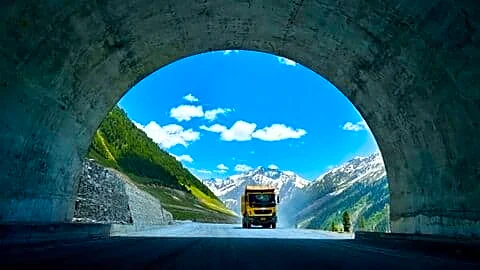
Sonamarg: At nearly 11,600 feet above sea level, where temperatures can plunge to minus 30 degrees and avalanches remain a constant threat, India is completing one of its most ambitious infrastructure projects - the Zojila Tunnel.The 13-kilometre tunnel, being built beneath the formidable Zojila Pass, is far more than an engineering marvel. It is a strategic lifeline that promises year-round connectivity between Kashmir and Ladakh, ending decades of winter isolation and significantly boosting India's military and logistical capabilities in the region.A Times Now ground report from the project site reveals the extraordinary challenges faced by engineers and workers tasked with tunnelling through one of the most hostile environments on Earth.Megha
Engineering & Infrastructure Limited (MEIL), a Hyderabad-based infrastructure major, is executing the Zojila Tunnel project on behalf of NHIDCL after securing the contract through a competitive bidding process in 2020. The company has undertaken the challenging task of constructing the tunnel in one of the world's toughest high-altitude terrains, ensuring year-round connectivity between Kashmir and Ladakh.
Ground Report from Zojila Tunnel
Times Now Ground Report
Battling Avalanches, Freezing Temperatures and Unpredictable Mountains
The Himalayas did not give up easily.Project documents show that geological conditions along the tunnel alignment changed 67 times, forcing engineers to constantly modify excavation plans and support structures. Workers battled unstable rock formations, water ingress, extreme weather and frequent avalanche threats.The site witnessed multiple avalanche incidents during construction. One of the most dramatic episodes occurred in January 2023, when more than 170 workers were stranded and had to be rescued after heavy snowfall cut off access routes.
Yet work never stopped.More than 1,200 personnel continued operations through harsh winters, sub-zero temperatures and dangerous terrain. Engineers relied on the New Austrian Tunnelling Method (NATM), coupled with continuous geotechnical monitoring, to safely navigate the mountain's unpredictable geology.The result is a project that many experts consider among the most challenging tunnel construction efforts ever undertaken in India.
Why Zojila Matters Beyond Connectivity
Once operational, the tunnel will provide all-weather connectivity between Srinagar and Leh, ensuring uninterrupted movement of civilians, goods, emergency services and military assets.For decades, the Zojila Pass remained inaccessible for months every winter due to heavy snowfall, cutting off Ladakh from the Kashmir Valley. The tunnel is expected to dramatically reduce travel disruptions and strengthen economic activity across the region.But the significance of the project extends far beyond transportation.Strategically, the tunnel comes at a time when China has accelerated infrastructure development along its frontier regions bordering India. Analysts have observed rapid expansion of logistics hubs, roads and airstrips near sensitive sectors in recent years.
Since the 2017 Doklam standoff, China has invested heavily in border infrastructure across Tibet and Xinjiang, reportedly constructing more than 60 bridges and over 1,400 kilometres of roads to improve military mobility along the frontier.India's response has been a major infrastructure push of its own, aimed at reducing logistical disadvantages and ensuring faster deployment capabilities in border regions.
From Chenab to Zojila: India's Infrastructure Transformation
The Zojila Tunnel is part of a broader infrastructure revolution reshaping India's strategic frontiers.
Chenab Rail BridgeThe world's highest railway arch bridge has permanently connected Kashmir to India's national railway network, transforming civilian mobility and enhancing military logistics.
Atal TunnelBuilt at high altitude in Himachal Pradesh, the tunnel significantly reduced travel time to Ladakh and strengthened access to key border regions.
Sela TunnelThe project provides all-weather connectivity to Tawang in Arunachal Pradesh, improving operational readiness near the Line of Actual Control with China.
Anji Khad BridgeIndia's first cable-stayed railway bridge is a critical component of the Udhampur-Srinagar-Baramulla rail project and a major engineering achievement.
New Pamban BridgeIndia's first vertical-lift sea bridge combines modern engineering with enhanced rail and maritime connectivity.
Sonamarg (Z-Morh) TunnelProviding year-round access to Sonamarg, the tunnel serves as a crucial precursor to the strategic Zojila corridor.
A Tunnel Through the Himalayas, A Message Beyond Them
The Zojila Tunnel represents more than concrete, steel and machinery. It reflects India's broader effort to overcome geographic barriers that have historically constrained connectivity and strategic mobility.As the tunnel nears completion, it stands as a symbol of how infrastructure is becoming a key instrument of national security. In a region where terrain has long dictated strategy, India is increasingly using engineering to change the equation.
/images/ppid_a911dc6a-image-178097926088918956.webp)


/images/ppid_59c68470-image-17808850742418759.webp)


/images/ppid_a911dc6a-image-178094543591230707.webp)





/images/ppid_59c68470-image-178083753720379111.webp)


/images/ppid_59c68470-image-178091007117058933.webp)