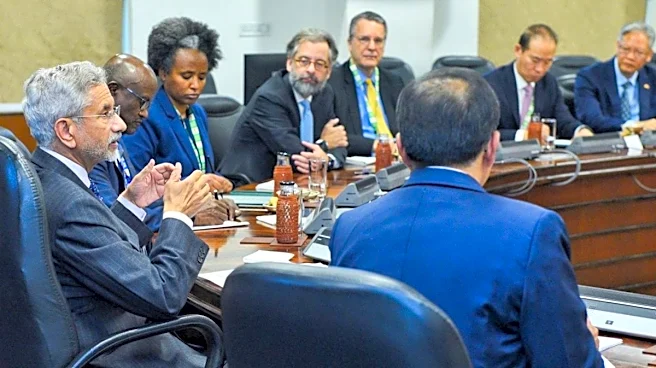
New Delhi: The United Kingdom on Thursday invited India for talks on the reopening of the Strait of Hormuz in the wake of escalating tensions in theMiddle East conflict. The development was confirmed by the Ministry of External Affairs (MEA). Randhir Jaiswal, the MEA spokesperson, said that Foreign Secretary Vikram Misri will participate in the talks. A total of 56 countries are participating in the 'Hormuz' talks. Other countries participating in the talks, include the United arab Emirates, France, Germany, Canada, Italy and Japan."The UK side has invited several countries, which also include India, for talks on the Strait of Hormuz. From our side, the Foreign Secretary is attending the meeting this evening," Jaiswal said. The MEA spokesperson further
added tnat India is in touch so smooth shipment through the Strait of Hormuz.
"We are in touch with Iran and other countries there to see how best we can get unimpeded transit and safe transit for our ships, which are carrying products including LPG, LNG and other products," he stated."Through this conversation that we have had over the last several days, we have had six Indian ships which have been able to safely cross the Strait of Hormuz, and we continue to be in touch with relevant parties," Jaiswal added.As per the Petroleum Ministry, India imports 60 per cent of its liquefied petroleum gas (LPG) consumption, and out of these imports, about 90 percent come through the Strait of Hormuz. Meanwhile, almost two weeks after the start of the conflict, the Petroleum Ministry had said that India secoured 70 per cent of crude oil outside the Strait of Hormuz.
Also Read: Beyond Hormuz: Three Alternate Routes Keeping India's Energy Supply Intact - EXPLAINEDLast month, Iran's Foreign Minister Abbas Araghchi said Tehran would permit ships from "friendly nations", including China, Russia, India, Iraq and Pakistan, to pass through the Strait of Hormuz. After the conflict, there has been a sharp decline in shipping through the strait.
About The Strait of Hormuz:The Strait of Hormuz has been blocked by Iran’s Islamic Revolutionary Guard Corps (IRGC) since the start of the conflict, following airstrikes by the United States and Israel on Tehran on February 28. It is a narrow waterway between Iran and Oman that connects the oil- and gas-producing Gulf countries to the rest of the world. Nearly one-fifth of the total energy trade happens through this route.
/images/ppid_a911dc6a-image-177513706488830291.webp)

/images/ppid_a911dc6a-image-177497842712714047.webp)
/images/ppid_a911dc6a-image-177492387404418600.webp)
/images/ppid_a911dc6a-image-177503563605160464.webp)

/images/ppid_a911dc6a-image-177512922689236957.webp)
/images/ppid_a911dc6a-image-177513443544245613.webp)
/images/ppid_a911dc6a-image-177513702974180721.webp)

/images/ppid_59c68470-image-177512253207119725.webp)



/images/ppid_59c68470-image-177496504077167096.webp)
/images/ppid_a911dc6a-image-177492643134732273.webp)