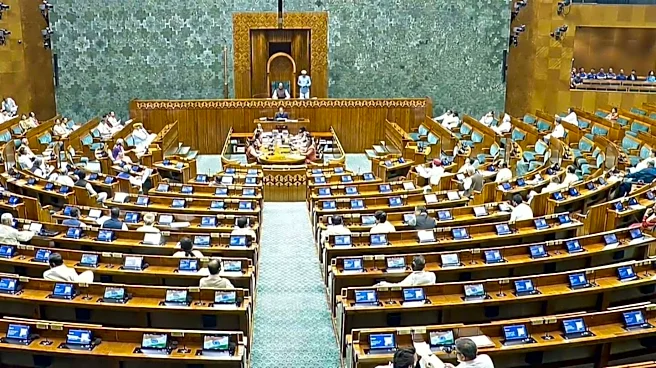
New Delhi: A stormy start to the special session of Parliament on Thursday saw sharp clashes between the government and the Opposition over the proposed amendment to the Women's Reservation Act 2023 and the Delimitation Bill, with heated exchanges, political jabs and competing claims dominating proceedings in the Lok Sabha. The Centre tabled three key bills - The Constitution (131st Amendment) Bill, 2026, the Delimitation Bill, 2026, and amendments related to Union Territories (Union Territories Laws (Amendment) Bill, 2026), aimed at implementing 33% reservation for women and expanding the Lok Sabha to around 850 seats. The debate quickly turned confrontational. While the government pitched the move as a historic reform to empower women and modernise
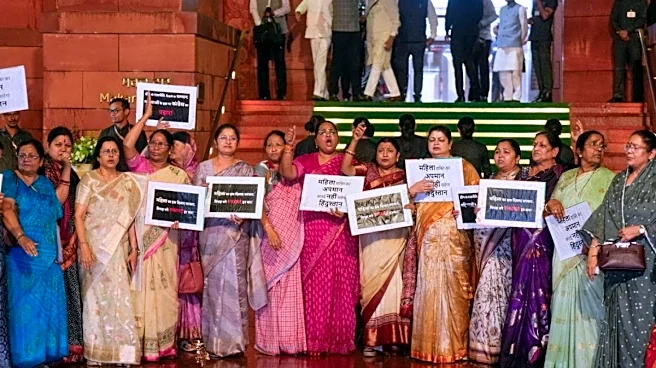
India’s electoral system, the Opposition questioned its timing, intent and linkage with delimitation. The House also witnessed sharp exchanges between leaders, protests by Opposition MPs, including black-clad demonstrations by DMK members and pointed remarks from Prime Minister Narendra Modi.
Delimitation: The Core Flaspoint
At the heart of the political battle is the delimitation exercise, which proposes redrawing parliamentary constituences and increasing Lok Sabha seats from 543 to around 850.
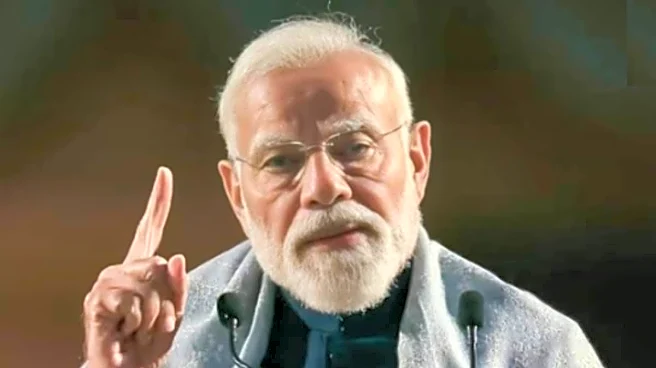
The government argues that:1. Expansion reflects population changes2. It will enable implementation of women’s reservation3. No state will lose representation proportionallyPrime Minister Narendra Modi has assured that "no state will lose anything". Emphasising clarity of intent, the Prime Minister said there was no need for wordplay when the government’s commitment was firm, adding that whether termed a “guarantee” or a “promise,” the assurance remains the same. Without naming the Opposition, he also took a swipe at critics, stressing that the government views India as one unified entity rather than in fragments. The Centre has maintained that the reforms are aimed at strengthening representation and inclusion, reiterating its position that there will be no bias and that what it calls a “Modi guarantee” ensures fair treatment for all states and regions.However, Opposition parties, especially from southern states, fear that delimitation could shift political power toward more populous northern states, reducing their relative influence.
Government Stand: ‘Historic Reform, No One Will Lose’
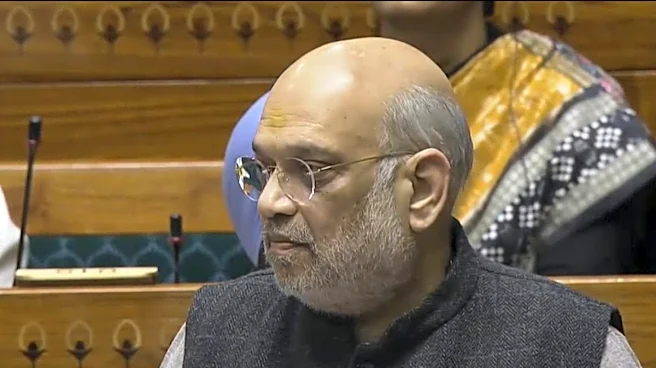
PM Modi framed the legislation as a long-pending reform aimed at empowering women and strengthening democracy. The Prime Minister told the lower house of parliament the proposals - which would also increase the number of legislators and women in regional assemblies and redraw constituencies - would move India in a "new direction"."I believe that (women's) voice in this house will bring new strength, fresh thinking, and a greater sense of sensitivity," he said.The government said the alterations to boundaries reflected population changes since seats were last fixed after a 1971 census.The Prime Minister also took a swipe at Opposition parties, joking about DMK leaders wearing black, calling it a “koala tika” on the bill. PM Modi said, “Apne yahan koi kaam karte hain aur us par nazar na lag jaye… aapka dhanyawad karta hoon, kala tika lagane ke liye.”Union Home Minister Amit Shah strongly defended the bills in the House. Shah accused southern states of pushing a misleading narrative on delimitation, citing data to argue they too would benefit from the exercise. "They asked where the figure of 850 came from. I will explain it. This figure of 850 is derived in the following way: Hypothetically, if there are 100 seats and 33 per cent reservation is to be given to women, then increasing the total seats by 50 per cent makes it 150. And when the reservation is applied as 33 per cent of 150, it automatically comes back to 100 seats," he said."So, with 543 members currently sitting, there will be a 50 per cent increase, and when 33 per cent is reserved for mothers, then all 543 seats will be open where women can also contest. So this 50 per cent has come about in this way. And 850 is a round figure -- 816 will be the exact number. They will ask again why this was done -- even now -- the round figure is not 543, it is more than 543," Shah added.
Opposition’s Stand
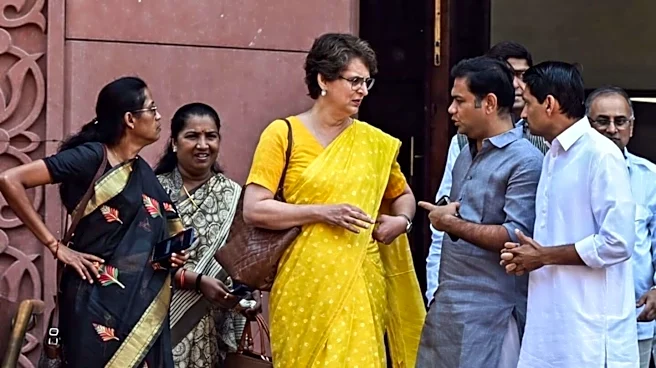
The Opposition strongly opposed the way the government is pushing the reforms. Congress leader and Lok Sabha MP K C Venugopal questioned the intent of the Bills tabled in the House. Speaking in Lok Sabha on the bill, which seeks to implement women's reservation from the 2029 general elections, he said the government intends to push delimitation in the garb of the Women's Reservation Amendment Bill.Referring to the opposition's objections to the Delimitation Bill and the manner in which seats are sought to be increased in Lok Sabha, he accused the government of using women's reservation as a weapon to destroy democracy in the country. "You are trying to diminish the status of the states for political ends. Withdraw the bill. Call an all-party meeting," he said.The Congress leader said that Prime Minister Narendra Modi, in his speech on the bill, did not mention the word "delimitation" even though it was the main issue today, as the Women's Reservation Bill had already been passed in 2023.Meanwhile, Congress MP Gaurav Gogoi accused the Centre of "creating hurdles" for implementing women's reservation and said that the Congress has always supported the same while urging to delink the women's quota from the delimitation process."Three years ago, the Union Home Minister spoke on similar lines as the Union Law Minister did today, that the women's reservation was historic, happening for the first time. We had said this then, and we are saying it now that Congress supports the women's reservation. But please make the women's reservation straightforward so that it is implemented as soon as it is passed," Gogoi said while speaking in Lok Sabha."It should not be linked with delimitation and should be implemented on the current strength of the Lok Sabha," Gogoi said, adding, "Don't bulldoze women's reservation, bring a Saral (straightforward) bill. We oppose these bills.""You are again and again creating hurdles for women's reservation. If you had listened to us in 2023, women's reservation would have been implemented in 2024. We are urging that women's reservation should not be linked with delimitation. If you do that, we will definitely support it. This bill is not for women's reservation, but it is for delimitation through the backdoor. This is your intention," he added.On the other hand, Samajwadi Party chief Akhilesh Yadav tore into the BJP, saying that it wants to delay the caste-based census because if conducted, the Centre will have to release the caste-based data and implement caste-based reservations for the backward communities.Speaking in the Lok Sabha, Yadav stressed that the Samajwadi Party welcomes the Women's Reservation Bill, which will reserve 1/3rd seats for women in the Parliament, but raised questions on the "motives" of the government in the rush of its implementation.He said that the BJP is "transforming women into slogans.""Samajwadi Party is in favour of the Women's Reservation Bill. We have always worked towards the growth of women. But the Bhartiya Janata Party is trying to turn a woman into a slogan. BJP must answer out of 21 States they are ruling, how many of the States have women Chief Ministers? Even your Delhi CM does not have the rights of a Chief Minister; she is a 'half Chief Minister'. I want to know why there is a hurry?" he asked.Earlier on Thursday, the Constitution (131 Amendment) Bill, 2026, the Delimitation Bill, 2026, and the Union Territories Laws (Amendment) Bill, 2026 were introduced in the Lok Sabha after the Opposition pressed for a division against the move to introduce three Bills, instead of a voice vote.As per the final division, there were a total of 251 AYES and 185 NOES out of the total 333 votes. The Lok Sabha primarily uses voice voting, but if challenged, a "division" is called, where the Automatic Vote Recorder (Ayes, Noes, Abstain) is utilised.The government has convened a special sitting of Parliament on April 16,17,18 to pass the amendment to the Nari Shakti Vandan Adhiniyam. It seeks opposition support for passing the amendment bill to implement the women's reservation bill from the 2029 Lok Sabha polls on the basis of the 2011 census.
/images/ppid_a911dc6a-image-177637982885929658.webp)

/images/ppid_a911dc6a-image-177638777278193552.webp)




/images/ppid_a911dc6a-image-177643703011099168.webp)
/images/ppid_a911dc6a-image-177650985765268910.webp)
/images/ppid_a911dc6a-image-17764787385213470.webp)
/images/ppid_a911dc6a-image-177641376600686714.webp)
/images/ppid_a911dc6a-image-177636426633193838.webp)