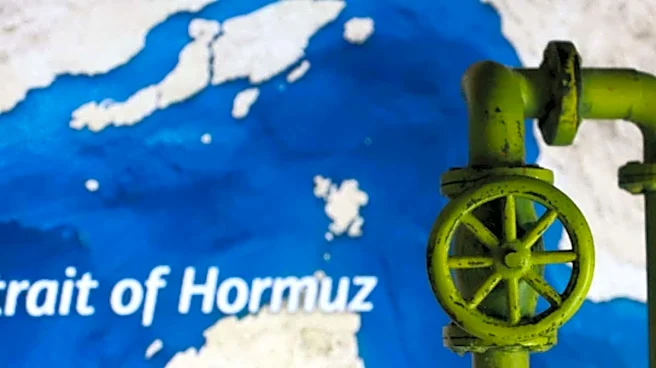
She doesn't know where the Strait of Hormuz is. She has never heard of Donald Trump, Pete Hegseth, Benjamin Netanyahu or Mojtaba Khamenei. She couldn't tell you who started the Iran war or why. She is a domestic help in a gated society in Noida. She came to work this morning. Before she started cleaning the kitchen, she asked the same question she has been asking every house in the building for the last three weeks: “Didi, cylinder hai kya? Humara agency bol raha hai dedh mahine ka wait hai. Dedh mahine. Ghar mein chulha band hai.”She is not the only one. Across the service stairs and guard rooms and maid quarters of urban India, a quiet, invisible crisis is unfolding. It's not on the news panels. It's not in Parliament's Question Hour. It's in the conversations
between maids, guards, delivery boys, and cooks — the people who run your building but don't live in it.
What They're Saying
Six voices. None from a TV studio. All from the service entrance.
“Humein kya pata war ka kya hoga. Hamara ghar to chulha band hai.” — Pushpa, domestic worker, Gurugram. Her last cylinder was delivered 40 days ago. The agency says the next slot is May.“Ladai bhi bade logon ki, suvidhaiyein bhi bade logon ki. Hum to dono taraf se marr rahe hain.” — Raju, security guard, Greater Noida. His wife is cooking on a borrowed kerosene stove. Kerosene is ₹120 per litre.“Induction le lo, sab bol rahe hain. Bhai, bijli hi nahi rehti. Aur bill? Pehle ₹800 aata tha, ab ₹1,600 aa raha hai. Induction chalao to ₹2,500 aayega.” — Sarita, cook, Dwarka. She runs two households on one salary.“Black mein cylinder mil raha hai — ₹2,500. Main ₹12,000 kamati hoon. Cylinder ke liye ek hafte ki kamai de doon?” — Meena, domestic worker, Vasant Kunj. Her husband is a daily wage labourer. There is no margin in their budget for a ₹2,500 cylinder.“Agency wale phone hi nahi utha rahe. Pehle ek din mein aa jaata tha. Ab booking karo, fir bhi pata nahi kab aayega.” — Kamla, housemaid, Patparganj. She has tried booking four times. Each time: “slot not available.”Rama, a social worker in Bhalaswa, northwest Delhi, known locally as "cylinder wali madam" for years of helping low-income residents get Ujjwala connections, told Mongabay-India: “The irony is, despite my nickname, I am struggling to secure an LPG cylinder myself.”
So What Government Is Doing?
This is not a story about government failure. The government has acted. The question is whether the actions reach the service stairs.The centre on April 8 eased LPG supply to industry, allocating 70 per cent of fuel demand to non-domestic bulk consumers, with priority given to pharma, food, steel, defence, agriculture and packaging sectors — a move aimed at preventing supply-chain disruptions amid the global crisis. Separately, a PNG connection drive added 3.16 lakh new piped gas connections, three times the March 2025 level, while over 16,700 households surrendered LPG connections, signalling a tangible shift away from cylinder dependency. The Group of Ministers was also briefed on easing energy prices following the ceasefire, and assured that key sectoral indicators will continue to be monitored closely.Union Petroleum Minister Hardeep Singh Puri addressed Parliament on March 12, calling the Hormuz closure “the first such closure in recorded history” and detailing emergency measures. Refineries have been ordered to maximise LPG output. The Essential Commodities Act has been invoked to regulate distribution and prevent hoarding. Commercial allocations were cut by up to 80% to protect household supply. Even raids are being conducted to curb black marketing.Tamil Nadu announced a ₹2/unit electricity subsidy for restaurants switching to induction. The government has allowed biomass, kerosene, and RDF pellets as temporary commercial fuels.These are real, documented measures. But the maid in Noida doesn’t know about the Essential Commodities Act. She knows that the agency said “dedh mahine”. And “dedh mahine” is five weeks of cooking on a borrowed stove.
Induction Feasible For All?
Everyone’s saying “buy an induction". Induction cooktop sales jumped 30-fold on Amazon. Flipkart reported 4x demand. Blinkit and Zepto sold out in metros. For the middle class, induction is a workaround. For the working class, it’s a trap.An induction cooktop costs ₹1,500–3,000. The pans cost extra (regular pans don’t work). And the electricity bill doubles. With power cuts picking up during summers, an induction stove is nothing but a paperweight. For Sarita in Dwarka, whose bill is already ₹1,600, induction isn’t a solution. It’s a second problem.
The Question Nobody Is Asking
India has 33.2 crore active LPG connections, as per the government record, and 10.4 crore of them are Ujjwala connections given specifically to families who couldn’t afford LPG otherwise. Those families didn’t have a backup plan then. They don’t have one now. The Ujjwala scheme succeeded in connecting them. But the Iran war just disconnected them — not from the pipeline, but from the price.The government is doing what governments do in a crisis: managing supply, raiding hoarders, diversifying imports, invoking emergency powers. Nobody is questioning the effort. But effort and outcome are two different things. Because right now, in a service stairwell in your building, a woman is asking the same question she asked yesterday and will ask again tomorrow:
“Didi, cylinder kab tak milega?” — And the honest answer, for 33 crore families, is: we don’t know. The war is 3,000 km away. The gas is 3,000 km away. But the kitchen is right here.”
/images/ppid_a911dc6a-image-177573506874038871.webp)

/images/ppid_a911dc6a-image-177552963554321784.webp)
/images/ppid_59c68470-image-17756500682168977.webp)

/images/ppid_a911dc6a-image-177571943153228355.webp)
/images/ppid_a911dc6a-image-177565963496494207.webp)


/images/ppid_59c68470-image-177563002819132492.webp)

/images/ppid_59c68470-image-177548003042968873.webp)